QRadar vs Splunk 2026: Real ₹ Costs & Which One to Pick
A practitioner's QRadar vs Splunk comparison: real India pricing (₹30 LPA–₹5 Cr+), detection strengths, cloud options, and a 30-day test to pick your SIEM.

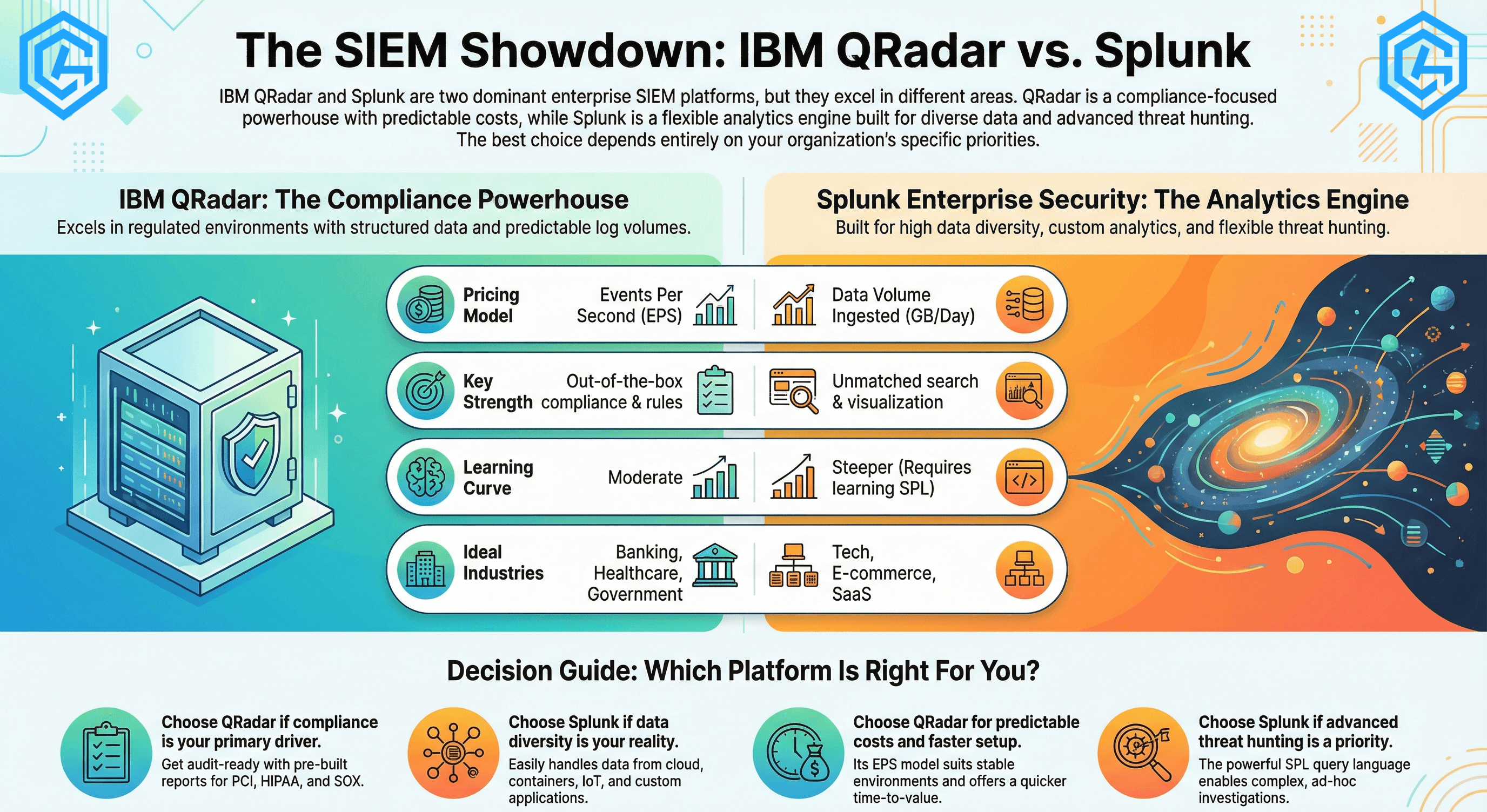
Executive Summary
Choosing between IBM QRadar and Splunk Enterprise Security is one of the most consequential decisions a security team will make. Both platforms dominate the enterprise SIEM market, but they serve different organizational needs, budgets, and operational models.
After implementing and managing both platforms across dozens of enterprises in India, the Middle East, and Europe, we have learned that the "better" SIEM depends entirely on your specific context: team size, data volumes, compliance requirements, and existing infrastructure.
This guide provides an honest, practitioner level comparison to help you make an informed decision.
Quick Comparison Table
| Factor | IBM QRadar | Splunk Enterprise Security |
|---|---|---|
| Pricing Model | EPS based (events per second) | Data volume (GB/day ingested) |
| Best For | Compliance heavy, structured environments | High volume, flexible analytics |
| Learning Curve | Moderate | Steeper (SPL query language) |
| Out of Box Content | Strong compliance rules, 450+ integrations | Extensive app ecosystem (Splunkbase) |
| Scalability | Vertical + horizontal | Horizontal (distributed architecture) |
| Cloud Option | QRadar on Cloud (QRoC) | Splunk Cloud |
| Typical Deployment | On premises, hybrid | Cloud first, on premises |
| Strength | Threat intelligence, UBA | Search flexibility, visualization |
Understanding the Platforms
IBM QRadar: The Compliance Powerhouse
QRadar has been a SIEM market leader since 2010 (acquired by IBM from Q1 Labs). It performs particularly well in environments where:
- Regulatory compliance is a primary driver (PCI DSS, HIPAA, SOX, RBI guidelines)
- Structured data sources dominate (firewalls, endpoints, databases)
- Predictable data volumes allow EPS based licensing to be cost effective
- Threat intelligence from IBM X Force is valuable
QRadar's architecture combines log management, flow analysis, vulnerability data, and user behavior analytics (UBA) in a unified platform. The Offense based correlation engine groups related events into actionable incidents, reducing alert fatigue.
Key Strengths:
- Pre built compliance reports and dashboards
- Network flow analysis (not just logs)
- Vulnerability and risk scoring built in
- Strong in regulated industries (BFSI, healthcare, government)
Splunk Enterprise Security: The Analytics Engine
Splunk started as a machine data platform and evolved into a security powerhouse. It performs particularly well when:
- Data variety is high (cloud, containers, custom applications, IoT)
- Advanced analytics and custom detection logic are priorities
- Search flexibility matters more than out of box rules
- Large scale environments require distributed architecture
Splunk's SPL (Search Processing Language) is extremely powerful but requires investment to master. The Splunkbase ecosystem provides thousands of apps and integrations, making it highly extensible.
Key Strengths:
- Unmatched search and visualization capabilities
- Extensive app marketplace (Splunkbase)
- Strong in cloud native and DevSecOps environments
- Excellent for threat hunting and custom analytics
Detailed Feature Comparison
1. Data Collection and Parsing
QRadar:
- 450+ device support modules (DSMs) out of the box
- Auto discovery of log sources
- Built in flow collection (NetFlow, sFlow, IPFIX)
- Custom parsing requires DSM Editor or professional services
Splunk:
- Splunk Add ons for common sources
- Flexible data onboarding (any data, any format)
- Heavy Forwarders for preprocessing
- Custom parsing via props.conf and transforms.conf
Verdict: QRadar wins for quick deployment with common enterprise sources. Splunk wins for flexibility with diverse or custom data.
2. Detection and Correlation
QRadar:
- Offense engine correlates events automatically
- 1,400+ pre built rules
- Anomaly detection via UBA (User Behavior Analytics)
- Magnitude scoring prioritizes threats
Splunk:
- Correlation searches run on schedule
- Risk Based Alerting (RBA) reduces noise
- MITRE ATT&CK framework mapping
- Extensive threat intelligence integrations
Verdict: QRadar is more turnkey with pre built logic. Splunk offers more flexibility but requires more tuning effort.
3. Investigation and Hunting
QRadar:
- AQL (Ariel Query Language) for searches
- Right click investigation workflows
- Network forensics built in
- Good for structured investigations
Splunk:
- SPL enables complex, ad hoc queries
- Superior visualization and dashboarding
- Threat hunting workbench
- Better for exploratory analysis
Verdict: Splunk is superior for threat hunting and complex investigations. QRadar is sufficient for standard incident workflows.
4. Compliance and Reporting
QRadar:
- Pre built compliance dashboards (PCI, SOX, HIPAA, GDPR)
- Scheduled reports with PDF export
- Audit ready documentation
- Strong in regulated industries
Splunk:
- Compliance apps available on Splunkbase
- Highly customizable dashboards
- Executive reporting capabilities
- Requires more configuration
Verdict: QRadar wins for out of box compliance. Splunk requires more setup but offers more customization.
Discuss your SIEM requirements with our experts
Pricing: The Elephant in the Room
QRadar Pricing Model
QRadar licenses based on Events Per Second (EPS) and Flows Per Minute (FPM):
| Tier | EPS | Typical Use Case |
|---|---|---|
| Entry | 1,000 EPS | Small enterprise, single site |
| Mid Market | 5,000 to 10,000 EPS | Multi site, moderate log volume |
| Enterprise | 25,000+ EPS | Large enterprise, high compliance |
Pros: Predictable costs if data volumes are stable.
Cons: Spikes in log volume can cause licensing issues; adding new sources requires capacity planning.
Splunk Pricing Model
Splunk licenses based on daily data ingestion volume (GB/day):
| Tier | Volume | Typical Annual Cost (India) |
|---|---|---|
| Entry | 10 GB/day | ₹30 to 50 LPA |
| Mid Market | 100 GB/day | ₹1.5 to 2.5 Cr |
| Enterprise | 500+ GB/day | ₹5+ Cr (negotiable) |
Pros: Flexible. Ingest any data without format restrictions.
Cons: Costs can escalate quickly; data management strategy is essential.
Cost Reduction Strategies
For QRadar:
- Tune log sources to reduce noise
- Use flow analysis instead of full packet capture
- Archive older data to cold storage
For Splunk:
- Implement data tiering (hot/warm/cold/frozen)
- Use summary indexing for frequently queried data
- Filter low value logs at collection time
- Consider Splunk workload pricing for predictable costs
When to Choose QRadar
QRadar is typically the better choice when:
- Compliance is the primary driver — Pre built reports for PCI DSS, SOX, HIPAA save significant effort
- Network flow analysis matters — NetFlow/IPFIX support without additional licensing
- Predictable data volumes — EPS based licensing is cost effective
- Faster time to value — Out of box rules and dashboards reduce implementation time
- IBM ecosystem — Existing IBM investments (Guardium, Verify, MaaS360) work well together
- Budget constraints — Often lower TCO for mid market deployments
Ideal Industries: Banking and financial services, healthcare, government, manufacturing
When to Choose Splunk
Splunk is typically the better choice when:
- Data diversity is high — Cloud native apps, containers, custom applications, IoT
- Threat hunting is a priority — SPL enables complex, ad hoc investigations
- You need flexibility — Build custom detections, dashboards, and workflows
- Cloud first strategy — Splunk Cloud is mature and well supported
- DevSecOps integration — Strong CI/CD and observability integrations
- Large SOC teams — Analysts can use SPL for advanced analysis
Ideal Industries: Technology, e commerce, SaaS, media, telecommunications
Real World Deployment Scenarios
Scenario 1: Mid Size Bank (BFSI)
Context: 2,000 employees, RBI compliance requirements, on premises infrastructure
Recommendation: IBM QRadar
Why:
- Pre built RBI/PCI compliance dashboards
- Predictable log volumes (structured enterprise sources)
- Lower TCO at this scale
- Network flow analysis for transaction monitoring
Scenario 2: SaaS Startup Scaling Rapidly
Context: 500 employees, AWS native, multiple microservices, DevSecOps culture
Recommendation: Splunk Cloud
Why:
- Cloud native architecture
- Flexible data ingestion from diverse sources
- Developer friendly integrations
- Scales with growth
Scenario 3: Healthcare Enterprise
Context: 5,000 employees, HIPAA compliance, mixed on prem and cloud
Recommendation: QRadar (hybrid deployment)
Why:
- HIPAA compliance reports out of the box
- Sensitive data stays on premises
- UBA for insider threat detection
- IBM X Force threat intelligence
Migration Considerations
Migrating FROM QRadar to Splunk
Common reasons:
- Need for more flexible analytics
- Cloud first transformation
- Growing beyond QRadar's licensing model
Key challenges:
- Rewriting correlation rules in SPL
- Retraining analysts on Splunk
- Data migration (historical logs)
Typical Timeline: 3 to 6 months for full migration
Migrating FROM Splunk to QRadar
Common reasons:
- Cost reduction (especially at high volumes)
- Simpler compliance reporting
- Consolidating IBM security stack
Key challenges:
- Losing SPL flexibility
- Rebuilding custom dashboards
- Flow collection architecture differences
Typical Timeline: 3 to 6 months for full migration
The Third Option: Multi SIEM or Alternatives
Some organizations run both platforms:
- QRadar for compliance reporting and regulated environments
- Splunk for advanced analytics and threat hunting
Emerging alternatives to consider:
- Microsoft Sentinel — Strong for Microsoft heavy environments
- Elastic Security — Open source option with commercial support
- Google Chronicle — Cloud native, fixed price model
If you are weighing a move off QRadar specifically, we cover this in depth in our guide to QRadar alternatives — a replacement shortlist filtered for Indian enterprises by data residency, CERT-In retention and SEBI CSCRF obligations, with realistic migration costs and the cases where staying on QRadar is the better call.
FAQ
Is QRadar cheaper than Splunk?
It depends on data volumes. QRadar is often cheaper for mid market deployments with predictable log volumes. Splunk costs can escalate quickly at high ingestion rates but offers more flexibility.
Which is better for log management and threat detection — Splunk or QRadar?
Splunk leads for log management and ad hoc analytics thanks to its SPL query language and flexible ingestion. QRadar leads for out-of-the-box, rule-based threat detection with strong compliance content and built-in UBA. If your priority is high-volume, flexible analytics, choose Splunk; if it's structured detection with a leaner team, choose QRadar.
What are the best QRadar alternatives?
Common QRadar alternatives include Splunk Enterprise Security, Microsoft Sentinel (cloud-native, strong for Microsoft-heavy estates), Elastic Security (open, cost-effective at scale), and Wazuh (open source). The right choice depends on your data volumes, cloud strategy, team skills, and compliance requirements. For Indian enterprises there is a further filter most shortlists skip — data residency and CERT-In log retention — which we work through in our QRadar alternatives shortlist for 2026.
How do QRadar, Splunk, and Microsoft Sentinel compare?
QRadar suits compliance-heavy, on-premises or hybrid environments; Splunk suits high-volume, analytics-driven SOCs; Sentinel suits cloud-first organisations already invested in Microsoft 365 and Azure, with pay-as-you-go pricing. Many enterprises shortlist two and run a 30-day proof of concept on their own log data.
Can I run QRadar in the cloud?
Yes. IBM offers QRadar on Cloud (QRoC) and QRadar SaaS. However, Splunk Cloud is generally more mature for cloud native deployments.
Which SIEM is better for threat hunting?
Splunk's SPL query language is more powerful for ad hoc threat hunting. QRadar is better for structured, rule based detection.
How long does SIEM implementation take?
Basic deployment: 4 to 8 weeks. Full operationalization with custom rules, integrations, and trained staff: 3 to 6 months.
Do I need a dedicated team to run a SIEM?
Yes. Even the best SIEM requires skilled analysts for tuning, investigation, and maintenance. Consider managed SIEM services if building an in house team is challenging.
Need Help Managing Your SIEM?
Choosing the right SIEM is only half the battle — operationalising it is where most enterprises struggle. Cyberaube Technologies provides 24/7 managed SIEM support services for both QRadar and Splunk, including rule tuning, alert triage, and platform optimisation.
If you're running QRadar or Splunk and need expert coverage without building an in-house team, explore our managed SIEM support services or speak to our team.
Related reading: SOC as a Service in India: A Complete Guide · Integrating SIEM and IAM: A Technical Playbook · Cybersecurity Staff Augmentation in India
Conclusion: There Is No Universal "Best"
Both QRadar and Splunk are excellent platforms used by thousands of enterprises globally. The right choice depends on:
- Your compliance requirements
- Data volumes and variety
- Budget constraints
- Team capabilities
- Existing infrastructure
Our Recommendation: Start with a clear assessment of your security operations requirements, data sources, and budget. If possible, run a proof of concept with both platforms.
At Cyberaube Technologies, we implement and manage both QRadar and Splunk, and we are genuinely platform agnostic. We recommend what fits YOUR environment, not what pays us commissions.
Get a platform agnostic SIEM recommendation
About the Author
Saurabh Pande is Co Founder of Cyberaube Technologies with 10+ years of hands on experience implementing IBM QRadar, Splunk, and other enterprise security platforms across BFSI, healthcare, and technology sectors.