Cybersecurity Staff Augmentation in India
Scale SOC, SIEM, IAM, GRC, and cloud security teams faster with Cyberaube's contract cybersecurity staffing and staff augmentation model.

Executive Summary
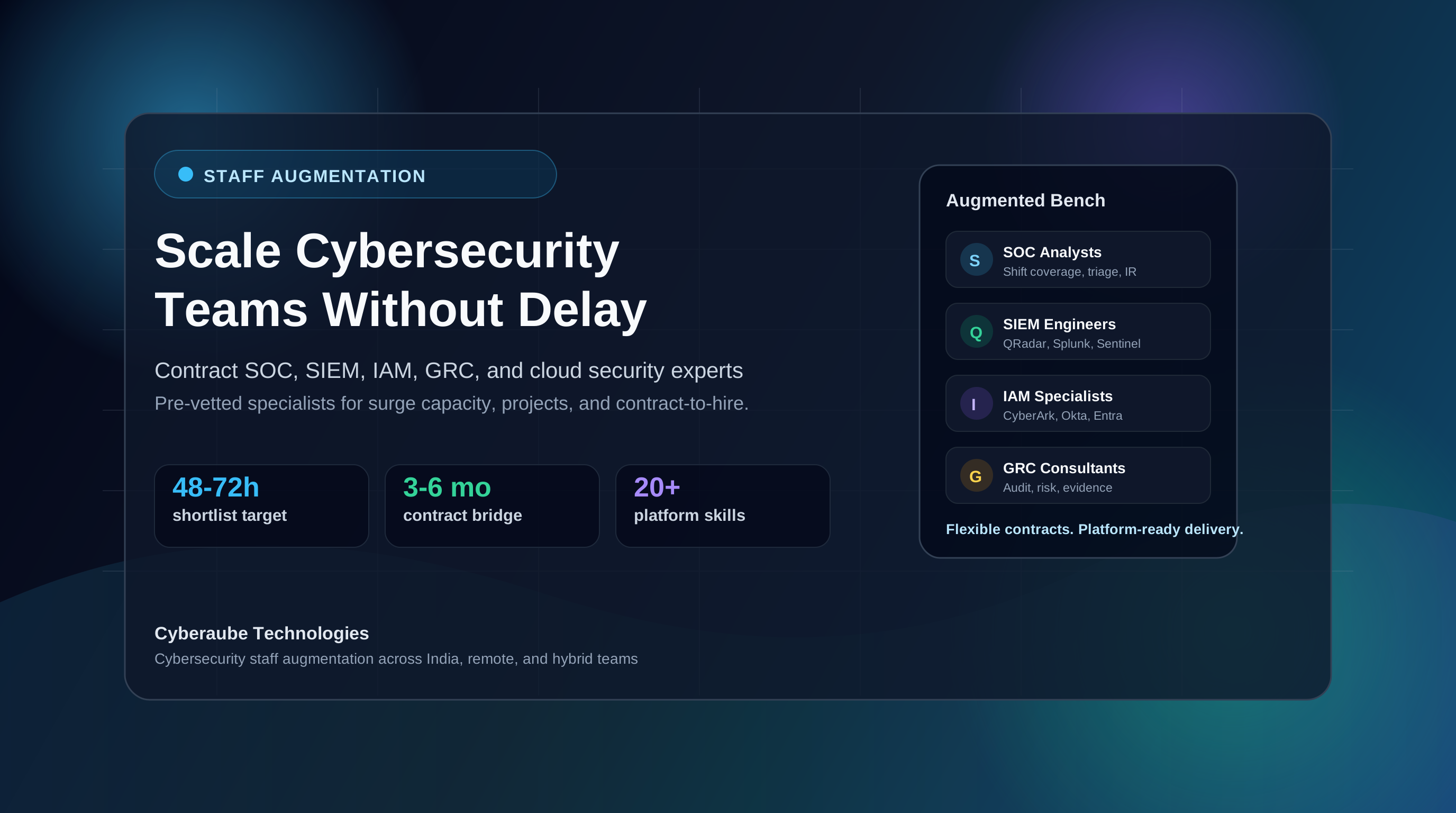
Cybersecurity staff augmentation in India helps organizations add skilled SOC analysts, SIEM engineers, IAM specialists, GRC consultants, and cloud security professionals without waiting through long permanent hiring cycles.
This model is useful when you need capability now, but you do not want to compromise on platform experience, screening quality, or compliance discipline. Instead of treating hiring as a resume-forwarding exercise, staff augmentation gives you access to pre-vetted professionals who can support specific tools, projects, shifts, audits, migrations, and operational gaps.
This guide explains:
- When staff augmentation is better than permanent hiring
- Which cybersecurity roles work best in contract staffing models
- How to evaluate staff augmentation partners in India
- How to avoid low-quality resume-vendor hiring
- How Cyberaube supports contract cybersecurity staffing across SOC, SIEM, IAM, GRC, and cloud security roles
If you are comparing models, read this alongside our guide to permanent staffing for cybersecurity roles in India.
Why Cybersecurity Staff Augmentation Matters in 2026
Security programs are under pressure from three directions at once: rising threat complexity, regulatory expectations, and shortage of experienced platform specialists.
Recent market signals explain why flexible cybersecurity staffing is becoming a practical operating model:
- Gartner projects information security spending in India to reach $3.4 billion in 2026, with security services also expected to grow.
- SANS/GIAC research highlights that the deeper issue is skills depth, not only open headcount.
- India continues to face gaps in niche domains such as identity architecture, platform security, privileged access management, digital forensics, and cloud-native security.
For CISOs and IT leaders, the takeaway is direct: you need a way to add skilled capacity without weakening standards. Staff augmentation fills that gap when permanent hiring is too slow and managed services are not the right fit.
What Is Cybersecurity Staff Augmentation?
Cybersecurity staff augmentation is a flexible hiring model where external security professionals work as part of your team for a defined duration, project, shift, or capability gap.
Unlike outsourcing, the augmented professionals typically operate under your processes, tools, and priorities. Unlike permanent hiring, the engagement can be ramped up, extended, converted, or ramped down based on business need.
Common use cases include:
- Adding SOC analysts for 24/7 monitoring or peak workload coverage
- Bringing in SIEM engineers for tuning, migration, or log source onboarding
- Hiring IAM specialists for access reviews, privileged access projects, or identity modernization
- Adding GRC consultants for audit readiness and evidence management
- Supporting cloud security reviews, hardening, and remediation
- Covering notice-period gaps while permanent hiring continues
Explore Cyberaube contract staffing
Staff Augmentation vs Permanent Hiring vs Managed Services
| Model | Best fit | Control | Speed | Long-term ownership |
|---|---|---|---|---|
| Staff augmentation | Skill gaps, project support, surge capacity, shift coverage | High | Fast | Medium |
| Permanent hiring | Core leadership, long-term platform ownership, institutional knowledge | High | Slower | High |
| Managed services | Outcome-based operations, 24/7 monitoring, tool administration | Medium | Fast | Shared |
The right model depends on the problem you are solving.
Choose staff augmentation when you already have security leadership and processes, but need more skilled hands. Choose permanent hiring when you need long-term ownership. Choose managed services when you want an external team to own defined outcomes.
For many enterprises, the strongest operating model is a blend:
- Permanent security leaders for strategy and ownership
- Staff augmentation for specialized projects and surge needs
- Managed services for continuous monitoring or platform operations
Roles That Work Well for Cybersecurity Staff Augmentation
Not every role should be filled the same way. Staff augmentation works best when the work is clearly scoped, skill-specific, and measurable.
SOC Analyst Staffing
SOC analyst staffing is useful when alert volumes increase, shifts need coverage, or internal analysts are overloaded.
Good contract SOC analysts should bring:
- Alert triage experience
- Incident documentation discipline
- Familiarity with SIEM workflows
- Escalation judgment
- Experience with tools such as QRadar, Splunk, Sentinel, ArcSight, or Elastic Security
Use contract SOC analysts for shift coverage, temporary backfill, incident workload support, and monitoring expansion.
SIEM Engineer Staffing
SIEM engineer staffing is one of the strongest use cases for staff augmentation because SIEM work is often project-based and platform-specific.
Use augmented SIEM engineers for:
- Log source onboarding
- Rule tuning and false-positive reduction
- Use-case development
- Dashboard and reporting improvements
- QRadar, Splunk, Sentinel, ArcSight, or Elastic Security migration support
- Compliance reporting support
The key is to validate production SIEM experience, not just resume keywords.
IAM Specialist Staffing
IAM specialist staffing helps teams handle access-heavy work without slowing down business operations.
Use contract IAM professionals for:
- Access review cycles
- Privileged access cleanup
- CyberArk, Okta, Microsoft Entra ID, SailPoint, or ForgeRock support
- SSO and MFA rollout support
- Joiner-mover-leaver workflow cleanup
- Identity governance and compliance evidence
IAM staff augmentation is especially useful when regulatory pressure or audit timelines require faster execution.
GRC Consultant Staffing
GRC consultants work well in staff augmentation models when the business needs audit readiness, policy maturity, evidence management, or risk register support.
Typical use cases include:
- DPDP Act readiness
- SEBI CSCRF support
- ISO 27001 evidence preparation
- Vendor risk reviews
- Control mapping
- Internal audit support
GRC staff augmentation works best when the consultant can work directly with security, legal, compliance, and business stakeholders.
Cloud Security and DevSecOps Staffing
Cloud security and DevSecOps roles are often needed for short, intense remediation or implementation windows.
Use augmented specialists for:
- Cloud posture reviews
- Security baseline hardening
- CI/CD security improvements
- Container and Kubernetes security checks
- Infrastructure-as-code review
- Cloud incident remediation
When to Use Contract Cybersecurity Staffing
Contract cybersecurity staffing is the right model when speed matters, but you still need accountability.
Use staff augmentation when:
- A permanent role is open but the work cannot wait
- A compliance audit has a fixed deadline
- A platform migration needs experienced hands
- Your SOC needs additional coverage
- Your internal team is overloaded
- You need niche expertise for a limited period
- You want to test a candidate before conversion to permanent employment
Avoid staff augmentation when the role is vague, the organization has no internal owner, or the expected output is not measurable. In those cases, define the scope first or consider managed services.
How to Evaluate a Cybersecurity Staff Augmentation Partner
The biggest risk in staff augmentation is confusing availability with capability. Fast profiles are not useful if they cannot perform in your environment.
Ask these questions before selecting a partner:
- Do you specialize in cybersecurity staffing or general IT recruitment?
- How do you validate platform experience?
- Can you screen for QRadar, Splunk, CyberArk, Okta, Entra ID, SailPoint, cloud security, and GRC experience?
- How quickly can you provide a qualified shortlist?
- Do you manage payroll, compliance, contracts, and replacement support?
- Can the resource work on-site, remote, or hybrid?
- What is your replacement process if the fit is poor?
- Can the contract be extended or converted to permanent employment?
A specialist partner should be able to explain the difference between SOC L1, SOC L2, SIEM engineering, IAM administration, IAM architecture, and GRC delivery. If the screening process is only keyword matching, the risk is high.
Cyberaube's Staff Augmentation Model
Cyberaube provides contract cybersecurity staffing for organizations that need platform-ready professionals without long hiring cycles.
1. Requirement Clarification
We define the role, tool stack, duration, shift expectation, work location, reporting structure, and success metrics.
2. Candidate Shortlisting
We shortlist professionals based on role fit, platform experience, availability, communication quality, and delivery readiness.
3. Technical Screening
Screening is aligned to the actual work. A SOC analyst, SIEM engineer, IAM specialist, and GRC consultant are not evaluated with the same checklist.
4. Contracting and Compliance
For contract staffing in India, Cyberaube can handle statutory and administrative requirements such as payroll coordination, documentation, and contractor management.
5. Deployment and Support
Contract resources can be deployed for short-term, long-term, or contract-to-hire engagements. If the requirement changes, the model can be extended, replaced, or converted.
Request a staff augmentation shortlist
Suggested Team Models
Here are practical staff augmentation patterns for common cybersecurity needs.
| Business need | Suggested augmented roles | Typical duration |
|---|---|---|
| SOC workload surge | SOC L1/L2 analysts, SOC lead | 1-6 months |
| SIEM tuning or migration | SIEM engineer, detection engineer | 2-6 months |
| IAM cleanup | IAM specialist, PAM engineer | 3-9 months |
| Audit readiness | GRC consultant, evidence coordinator | 2-4 months |
| Cloud security remediation | Cloud security engineer, DevSecOps engineer | 1-6 months |
| Permanent hiring bridge | Contract resource with conversion option | 3-6 months |
The best model is specific. Define the outcome first, then choose the role and duration.
Pricing Considerations for Staff Augmentation
Cybersecurity staff augmentation pricing depends on seniority, skill scarcity, location model, shift expectations, contract duration, and platform requirements.
Important pricing variables include:
- Junior, mid-level, senior, or architect-level experience
- On-site, remote, or hybrid delivery
- Standard business hours or shift coverage
- Short-term or long-term contract
- Contract-to-hire option
- Platform specialization such as QRadar, Splunk, CyberArk, Okta, SailPoint, Entra ID, cloud security, or GRC
Do not evaluate contract staffing only on monthly cost. A lower-cost profile who cannot work independently creates hidden cost through rework, delays, and management overhead.
Practical Action Plan
If you need cybersecurity staff augmentation this quarter, use this sequence.
Step 1: Define the Gap
Write down whether the gap is workload, skill, project, shift coverage, compliance, or platform-specific.
Step 2: Define the Output
A good requirement says what the person must deliver, not only what title they should hold.
Step 3: Choose the Model
Decide whether the role should be short-term contract, long-term contract, or contract-to-hire.
Step 4: Validate Platform Depth
Ask screening questions tied to your environment. For SIEM, ask about log sources, tuning, and use cases. For IAM, ask about access workflows and privileged access. For GRC, ask about evidence and control ownership.
Step 5: Set the First 30 Days
Define onboarding, access, reporting, deliverables, and review checkpoints before the resource starts.
FAQ: Cybersecurity Staff Augmentation in India
What is cybersecurity staff augmentation?
Cybersecurity staff augmentation is a flexible hiring model where external security professionals join your team for a defined period, project, shift, or skill gap.
How is staff augmentation different from outsourcing?
In staff augmentation, the professionals usually work under your direction and processes. In outsourcing or managed services, the external provider owns defined outcomes.
Which cybersecurity roles are best suited for staff augmentation?
SOC analysts, SIEM engineers, IAM specialists, GRC consultants, cloud security engineers, DevSecOps engineers, and incident response specialists are strong candidates when the work is clearly scoped.
Can contract cybersecurity staff be converted to permanent employees?
Yes. Contract-to-hire is often useful for senior or high-trust roles where the organization wants to evaluate fit before making a permanent offer.
How fast can Cyberaube provide cybersecurity staff augmentation?
Timelines depend on role complexity, seniority, location, and availability. Contract roles can often move faster than permanent hiring when the scope is clear and the required platform skills are well defined.
On-Site, Remote, or Hybrid: Choosing the Deployment Model
Staff augmentation is not only a question of who you hire — it is a question of where they sit. The model you choose changes both cost and coverage.
On-site staffing for core operations
Some roles need physical presence, whether for infrastructure access, regulatory reasons, or collaboration intensity. On-site deployment remains the right call for:
- Security operations and monitoring teams
- Infrastructure and data centre roles
- Compliance-driven environments with access restrictions
- High-trust enterprise deployments
For these roles, vet for reliability and organizational fit as seriously as for technical skill — an on-site engineer who cannot work with your existing team costs more than an unfilled seat.
Remote staffing for reach and coverage
Remote hiring widens the talent pool well beyond your city and, done properly, offers:
- Faster access to niche skill sets
- Cost efficiency without a quality trade-off
- Round-the-clock operational coverage across time zones
- Scalability for both short and long engagements
The discipline that makes remote work is unglamorous: structured technical screening, platform validation, and clear deployment readiness criteria before anyone starts.
The hybrid middle ground
Most mature security teams end up hybrid — a lean permanent core on-site, augmented by remote specialists for depth. That structure lets you scale during audits, migrations, or incidents without carrying the overhead year-round, and it responds faster than either extreme.
Frequently Asked Questions
What is the difference between on-site and remote staffing?
On-site staffing involves professionals working from a physical location, often required for infrastructure access or compliance. Remote staffing allows professionals to work from anywhere while contributing to the same operational goals.
How quickly can skilled professionals be deployed?
With structured vetting and a ready talent pool, deployment can often be completed within a few days, depending on role complexity and engagement type.
Are contract roles suitable for critical projects?
Yes. Contract professionals are well suited to audits, migrations, incident response, and other time-bounded initiatives when sourced through a specialist staffing partner.
How do organizations ensure quality in remote hiring?
Through rigorous technical assessments, platform validation, experience verification, and ongoing performance alignment — not through CV screening alone.
Can staffing models scale with business growth?
Yes. Flexible staffing models let organizations scale teams up or down without committing to long-term overhead.
Related Cybersecurity Staffing Resources
- Cybersecurity staffing services by Cyberaube
- Permanent Staffing for Cybersecurity Roles in India
- SOC as a Service in India: Complete Guide
Scale Security Capability Without Waiting Months
Cybersecurity staff augmentation is not a shortcut around quality. It is a practical way to add vetted, platform-ready capability when timelines are tight and internal teams are stretched.
Cyberaube Technologies helps organizations scale SOC, SIEM, IAM, GRC, cloud security, and security operations teams through contract staffing, long-term contracts, and contract-to-hire models.