Permanent Staffing for Cybersecurity Roles in India
How to hire permanent SOC, SIEM, IAM, GRC, and security leadership talent in India — role selection, screening, salary benchmarks, and 90-day replacement terms.

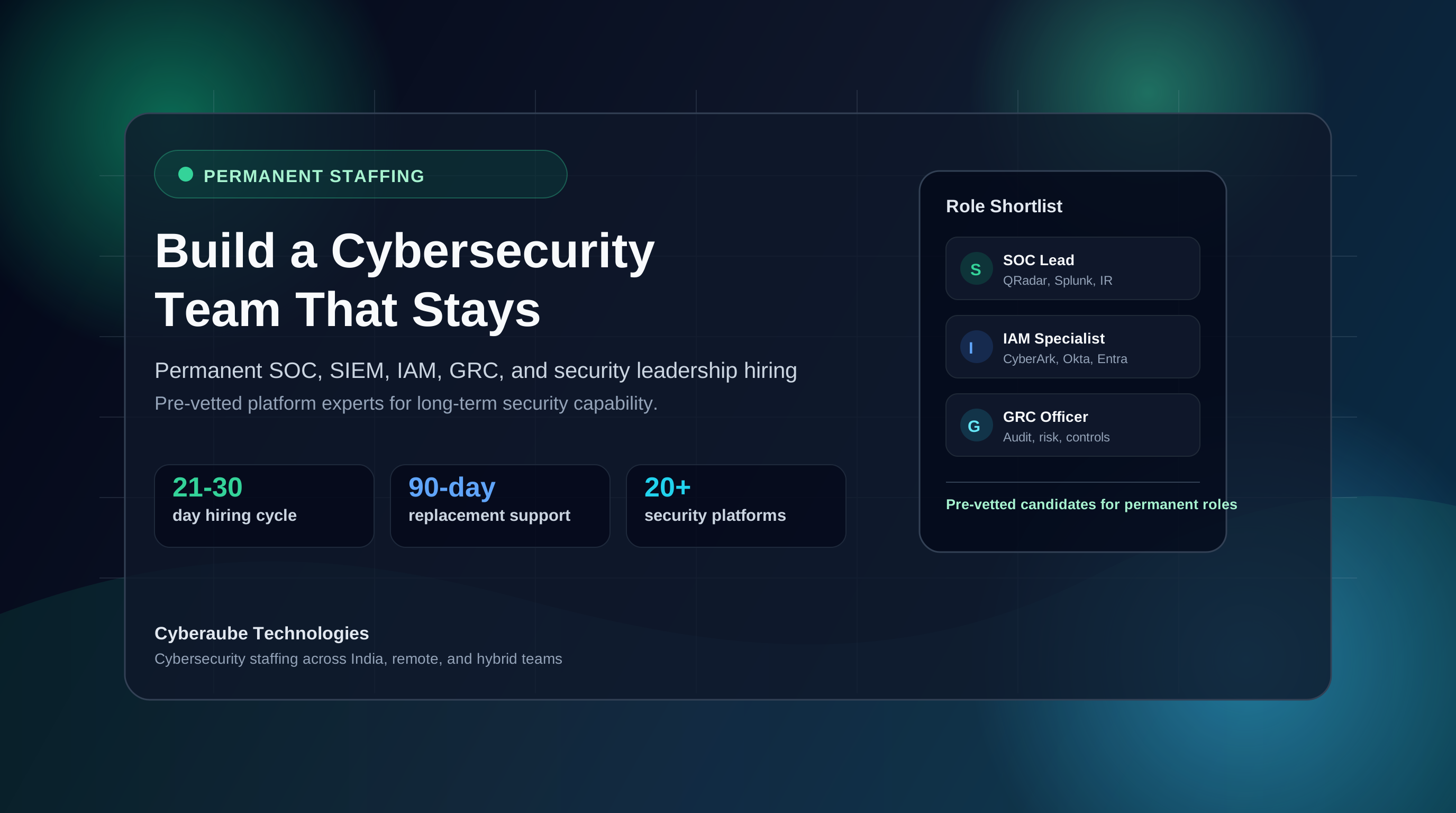
Executive Summary
Permanent staffing for cybersecurity roles in India is the right model when security capability needs to become part of the organization, not just a temporary project resource. If you are building a SOC, strengthening identity controls, preparing for recurring audits, or hiring security leadership, the goal is not only to fill a vacancy. The goal is to build continuity.
This guide explains how organizations should approach permanent cybersecurity staffing services in India, including:
- Which cybersecurity roles should usually be permanent
- How permanent hiring differs from contract staffing
- What a strong cybersecurity staffing partner should validate before shortlisting candidates
- How to reduce hiring risk with structured assessments, salary benchmarking, and replacement terms
- How Cyberaube helps enterprises hire platform-ready professionals for long-term roles
For urgent project capacity, contract staffing still has a place. But for roles that own security posture, culture, governance, and platform maturity, permanent placement is usually the stronger business decision.
If you need flexible or project-based capacity instead, read our companion guide to cybersecurity staff augmentation in India, which covers contract models, on-site versus remote deployment, and how to evaluate a staffing partner.
The Cybersecurity Talent Gap in India: Numbers That Demand Action
Permanent hiring in this market is difficult for a structural reason: demand has outrun supply, and it has done so faster than the training pipeline can respond.
Demand outpacing supply
- 1.5 million cybersecurity professionals needed by 2026
- 800,000+ current professional shortage
- 25,000–30,000 active cybersecurity openings, with only around 50% being filled
- 14% year-over-year increase in cybersecurity job postings (Sep 2023–Sep 2024)
- 93% of Indian firms increasing cybersecurity budgets, with 17% planning increases of 15%+
The gap is wide enough that the opportunity cost of an unfilled security role — an unmonitored SIEM, a delayed audit, an identity project that stalls — usually exceeds the cost of hiring well.
Why the shortage persists
- Accelerating threat landscape: India recorded 369 million malware detections in 2024.
- Rapid digitization: healthcare, fintech, e-commerce, and government initiatives create constant new hiring pressure.
- A skills gap, not only a talent gap: hands-on experience with enterprise platforms — QRadar, Splunk, CyberArk, Okta, Entra — is far scarcer than headcount numbers suggest.
That last point is the one that matters most for permanent roles. A candidate who has read about a platform and a candidate who has run it in production during an incident are not interchangeable, and CVs rarely distinguish them.
Why Permanent Cybersecurity Staffing Matters in India
Cybersecurity teams carry institutional memory. They understand your applications, network patterns, identity flows, incident history, audit gaps, vendor dependencies, and business constraints. That knowledge compounds over time.
Permanent staffing is especially valuable when the role influences:
- Long-term security architecture
- Incident response maturity
- Compliance ownership
- Platform roadmap decisions
- Cross-functional trust with IT, legal, risk, and business teams
- Retention of operational knowledge
A contractor can help solve a defined problem quickly. A permanent hire helps the organization build repeatable capability.
When Permanent Staffing Services Are the Right Model
Permanent hiring is usually the better choice when the work is continuous, strategic, or deeply tied to business context.
Choose Permanent Staffing For
- SOC leads and managers who own detection quality, escalation discipline, and analyst development
- SIEM engineers responsible for long-term tuning, use-case maturity, and reporting reliability
- IAM specialists managing privileged access, identity governance, and access review cycles
- GRC and compliance officers accountable for policies, audits, risk registers, and evidence management
- Security architects defining platform direction, cloud controls, and zero-trust roadmaps
- CISOs, directors, and senior security leaders responsible for governance and board-level reporting
Use Contract Staffing For
- Temporary SOC coverage
- Audit preparation sprints
- SIEM migration support
- IAM rollout projects
- Incident response surge capacity
- Short-term platform administration gaps
Most mature teams blend both. Permanent roles hold ownership. Contract roles add speed and specialized capacity.
Discuss your permanent cybersecurity hiring plan
Permanent vs Contract Cybersecurity Staffing
| Decision factor | Permanent staffing | Contract staffing |
|---|---|---|
| Best use case | Long-term ownership and team building | Project delivery, urgent coverage, temporary capacity |
| Timeline priority | Fit, retention, capability depth | Speed and availability |
| Knowledge retention | High | Medium unless converted |
| Cultural fit | Critical | Important, but usually secondary to delivery fit |
| Commercial model | One-time placement fee based on annual CTC | Monthly billing or agreed contract rate |
| Risk control | Screening, references, replacement guarantee | Rapid replacement and flexible ramp-down |
| Ideal roles | SOC lead, SIEM engineer, IAM specialist, GRC officer, architect, CISO | Project SIEM engineer, temporary SOC analyst, audit support, migration specialist |
The mistake many companies make is treating every open role the same. A strong staffing decision starts by asking what the role must own after six months, not only what tasks it must complete in the first week.
Permanent Cybersecurity Roles Cyberaube Helps You Hire
Cyberaube focuses on cybersecurity roles where generic recruitment often fails because the hiring decision depends on platform experience, operational maturity, and judgment under pressure.
SOC Analysts and SOC Leads
Permanent SOC hires should understand more than alert queues. They need practical experience with triage, escalation, false-positive reduction, incident documentation, and communication during pressure.
For SOC lead roles, assess:
- Detection quality ownership
- Analyst coaching ability
- Incident escalation discipline
- Experience with QRadar, Splunk, ArcSight, Microsoft Sentinel, or similar platforms
- Ability to convert recurring incidents into better playbooks
SIEM Engineers
SIEM engineers are often mislabeled as generic security engineers. The right permanent SIEM hire can improve detection fidelity, log source coverage, correlation rules, retention decisions, compliance reporting, and analyst productivity.
Assess candidates for:
- Real-world SIEM administration
- Use-case creation and tuning
- Log source onboarding
- Search/query fluency
- Troubleshooting under production constraints
- Understanding of security operations workflows
IAM Specialists
Identity is now a board-level security concern. Permanent IAM specialists help organizations mature access control, privileged access, access reviews, federation, and identity lifecycle processes.
Look for hands-on exposure to platforms such as CyberArk, Okta, Microsoft Entra ID, SailPoint, ForgeRock, or similar identity ecosystems.
GRC and Compliance Professionals
GRC roles require more than policy writing. A strong permanent GRC hire understands evidence, risk prioritization, audit preparation, control ownership, and stakeholder follow-through.
In regulated sectors, this role often becomes the bridge between cybersecurity operations and executive accountability.
Security Architects and Senior Leaders
Permanent security architects, directors, and CISOs should be hired for judgment, not only certifications. They must translate business goals into security roadmaps and make trade-offs across cost, risk, usability, and compliance.
What Makes Cybersecurity Permanent Hiring Difficult
Cybersecurity permanent hiring fails when the process is built around resumes instead of operating reality. A general staffing agency may recognize job titles, but a specialist cybersecurity staffing agency must validate platform depth, incident judgment, compliance awareness, and long-term fit.
Common failure points include:
- Job descriptions that combine too many unrelated responsibilities
- Screening based on keywords rather than production experience
- Interview panels that cannot validate platform depth
- Salary bands that are not aligned with market demand
- Slow interview cycles that lose strong candidates
- Overlooking cultural fit and communication quality
- No replacement or backfill plan if the hire does not work out
Permanent staffing needs structure. Speed matters, but bad speed creates long-term cost.
Cyberaube's Permanent Staffing Process
Cyberaube's permanent staffing process is built around role clarity, candidate quality, and risk reduction.
1. Requirement Analysis
The first step is to define the role accurately. For cybersecurity hiring, this means clarifying:
- Platform environment
- Reporting structure
- On-site, remote, or hybrid expectations
- Critical certifications, if any
- Required hands-on experience
- Industry and compliance context
- Salary range and joining timeline
This prevents the most common hiring problem: searching for the wrong profile.
2. Candidate Sourcing
Specialized cybersecurity sourcing is different from general IT hiring. The search must map role titles to real capability. A SIEM engineer, SOC analyst, IAM consultant, and GRC specialist may all use similar resume keywords, but they solve different business problems.
3. Screening and Assessment
Permanent candidates should be assessed for technical depth, practical judgment, communication, reliability, and cultural fit.
Useful screening methods include:
- Platform-specific technical discussions
- Scenario-based incident questions
- Architecture or workflow walkthroughs
- Compliance evidence examples
- Reference checks
- Salary and expectation alignment
4. Shortlist Presentation
A useful shortlist should be small and defensible. The goal is not to send many profiles. The goal is to present candidates who can realistically succeed in the environment.
For most permanent roles, Cyberaube targets a focused shortlist of qualified candidates rather than broad resume forwarding.
5. Interview Coordination
Cybersecurity candidates often evaluate the employer as carefully as the employer evaluates them. Fast scheduling, clear feedback, and a structured process improve offer acceptance.
6. Offer and Onboarding Support
Permanent staffing does not end at selection. Offer management, salary negotiation, joining follow-up, documentation, background verification, and onboarding coordination all reduce drop-off risk.
How to Evaluate a Permanent Staffing Agency in India
Before choosing a staffing agency, ask direct questions. A capable cybersecurity staffing partner should answer these clearly.
Questions to Ask
- Which cybersecurity roles do you specialize in?
- How do you validate platform experience?
- Can you screen for QRadar, Splunk, CyberArk, Okta, Entra ID, SailPoint, cloud security, or GRC experience?
- What is your average time-to-shortlist?
- How many candidates do you usually present per role?
- What replacement guarantee do you provide?
- How do you support salary benchmarking?
- How do you reduce offer drop-off?
- Do you understand on-site, remote, and hybrid delivery expectations?
If the answers are vague, the partner is likely operating as a resume vendor, not a specialist staffing provider.
For a broader partner evaluation framework, including on-site and remote delivery models, see our guide to cybersecurity staff augmentation in India.
Permanent Staffing Pricing and Risk Control
Permanent staffing fees are usually tied to the selected candidate's annual CTC. Cyberaube keeps this model transparent.
| Role seniority | Typical fee model |
|---|---|
| Junior roles, 0-3 years | 8.33% of annual CTC |
| Mid-level roles, 3-8 years | 12.5% of annual CTC |
| Senior and leadership roles, 8+ years | 16.67% of annual CTC |
The commercial model should be evaluated against business impact. A delayed SOC lead, SIEM engineer, IAM specialist, or compliance officer can create operational exposure that costs more than the hiring fee.
Risk controls should include:
- Pre-vetted candidates
- Technical screening
- Cultural fit assessment
- Background verification
- Reference checks
- Offer management
- 90-day replacement guarantee
Permanent Cybersecurity Hiring Plan for This Quarter
If you are planning permanent cybersecurity hiring, start with a simple role-priority map.
Step 1: Separate Ownership Roles From Project Roles
Identify which roles must stay inside the organization. These are usually permanent positions.
Step 2: Define Platform Requirements
Be specific. "SIEM experience" is not enough. State whether the role needs QRadar, Splunk, Sentinel, ArcSight, or another platform.
Step 3: Set Decision Timelines
Strong candidates move quickly. Define interview rounds, decision owners, and feedback timelines before sourcing begins.
Step 4: Benchmark Compensation
Salary misalignment wastes time. Confirm the budget before presenting the role to senior candidates.
Step 5: Use Contract Support Where Needed
If the permanent role is urgent but the right hire will take time, use contract staffing to cover immediate operational gaps while the permanent search continues.
Request a shortlist for permanent cybersecurity roles
FAQ: Permanent Cybersecurity Staffing
What is permanent staffing for cybersecurity roles?
Permanent staffing is the recruitment and placement of full-time cybersecurity professionals who join the client organization directly. It is best suited for roles that require long-term ownership, cultural fit, and continuity.
Which cybersecurity roles are best suited for permanent hiring?
SOC leads, SIEM engineers, IAM specialists, GRC officers, cloud security engineers, security architects, and security leaders are strong candidates for permanent hiring when they own recurring responsibilities.
How long does permanent cybersecurity hiring usually take?
Timelines depend on seniority and role complexity. With a specialized staffing process, a qualified shortlist can often be prepared quickly, while final hiring depends on interviews, offer negotiation, notice period, and onboarding.
Should I choose permanent or contract staffing?
Choose permanent staffing for long-term ownership and team building. Choose contract staffing for urgent coverage, project-based work, or temporary capacity. Many organizations use both.
What makes Cyberaube different from a general staffing agency?
Cyberaube focuses on cybersecurity and platform-ready professionals across SOC, SIEM, IAM, GRC, cloud security, and security leadership roles. The process emphasizes technical validation, cultural fit, salary alignment, and replacement support.
Related Cybersecurity Staffing Resources
- Cybersecurity staffing services by Cyberaube
- Cybersecurity Staff Augmentation in India
- SOC as a Service in India: Complete Guide
Build a Security Team That Stays
Permanent cybersecurity staffing is not just recruitment. It is workforce architecture. The right hires preserve context, improve security maturity, and reduce recurring dependency on emergency hiring.
Cyberaube Technologies helps organizations hire pre-vetted cybersecurity professionals for long-term roles across India, with remote and hybrid options where appropriate.
Explore Cyberaube staffing services or contact our team.
Related reading: Cybersecurity Staff Augmentation in India · SOC as a Service in India: Complete Guide