SOC as a Service in India: A Complete Guide for 2026
SOC as a Service in India: how it works, real INR pricing bands, what to check in a provider, and a framework for in-house vs outsourced.

Executive Summary
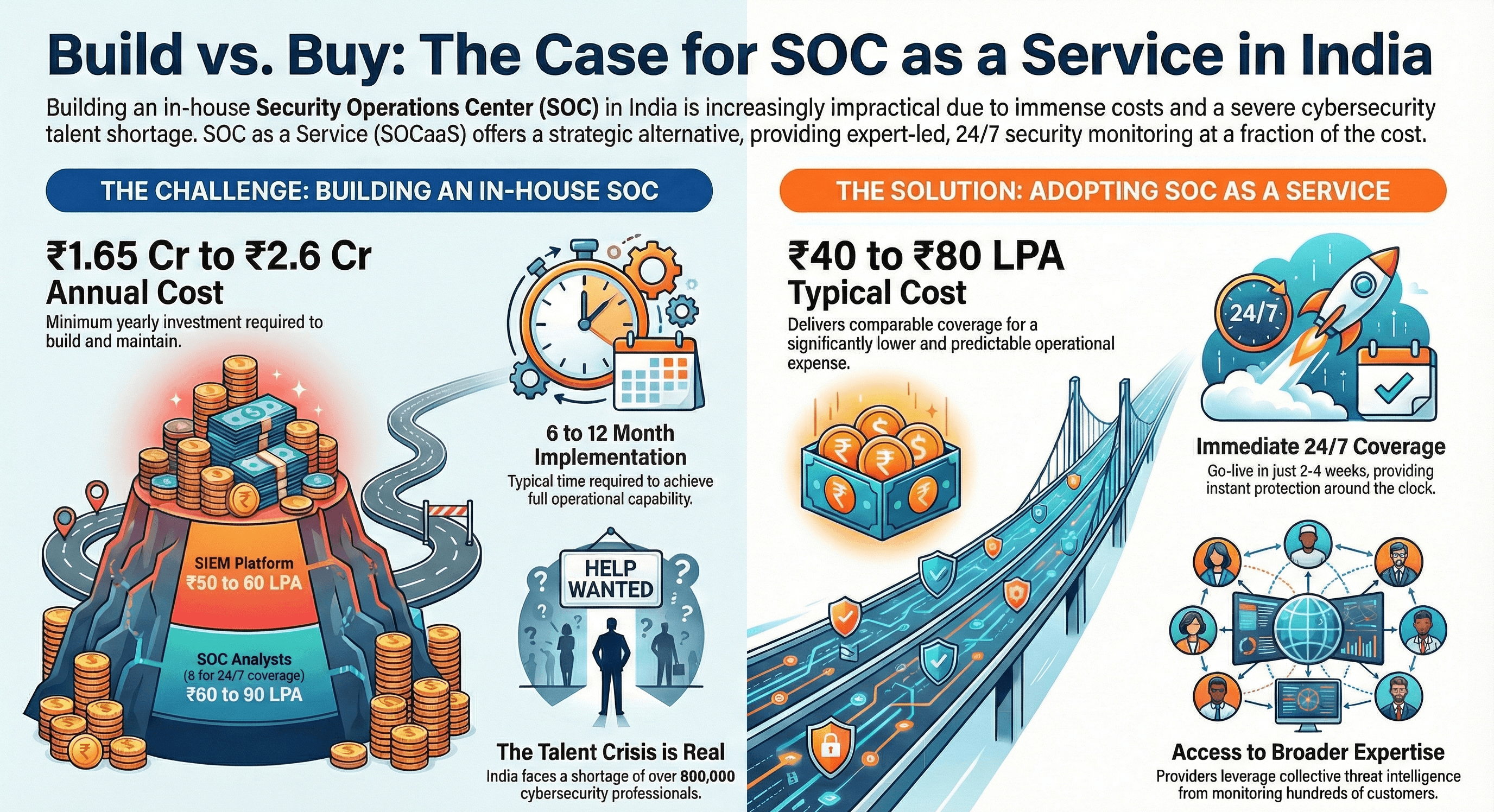
Building an in house Security Operations Center (SOC) is expensive, time consuming, and increasingly impractical for most organizations. The talent shortage alone, with 800,000+ unfilled cybersecurity positions in India, makes 24/7 coverage a significant challenge.
SOC as a Service (SOCaaS) offers an alternative: outsourced security monitoring, threat detection, and incident response delivered by specialized providers. In 2026, SOCaaS has matured from a cost cutting measure to a strategic capability that often outperforms in house operations.
This guide covers everything you need to know about SOC as a Service in India, from how it works to what it costs to how to choose the right provider.
What is SOC as a Service?
SOC as a Service is a subscription based model where a third party provider delivers continuous security monitoring, threat detection, and incident response on your behalf. It combines:
- Technology: SIEM platforms, threat intelligence feeds, automation tools
- People: Trained SOC analysts working 24/7/365
- Processes: Playbooks, escalation procedures, reporting frameworks
Think of it as having a fully staffed Security Operations Center without building one yourself.
SOCaaS vs Related Services
| Service | What It Covers | Best For |
|---|---|---|
| SOC as a Service (SOCaaS) | Monitoring, detection, triage, basic response | Broad security operations coverage |
| Managed Detection and Response (MDR) | Deeper investigation, active threat hunting, response | Organizations wanting active threat hunting |
| Managed SIEM | SIEM platform management, tuning, maintenance | Organizations with SIEM but lacking expertise |
| MSSP (Managed Security Services) | Broader services including firewalls, endpoints | Full outsourcing of security infrastructure |
In practice, these terms often overlap. Focus on the specific capabilities offered rather than the label.
Why SOCaaS is Growing in India
The Build vs Buy Math Has Changed
Cost to build an in house SOC:
| Component | Annual Cost (INR) |
|---|---|
| SIEM Platform (mid market) | ₹50 to 80 LPA |
| SOC Analysts (6 FTEs for 24/7) | ₹60 to 90 LPA |
| SOC Manager | ₹25 to 35 LPA |
| Threat Intelligence Feeds | ₹10 to 20 LPA |
| Training and Certifications | ₹5 to 10 LPA |
| Infrastructure and Tools | ₹15 to 25 LPA |
| Total | ₹1.65 to 2.6 Cr per year |
SOCaaS Typical Cost: ₹40 to 80 LPA for comparable coverage
The economics are clear: for most mid market organizations, SOCaaS delivers better outcomes at lower cost.
The Talent Crisis is Real
- 800,000+ cybersecurity professionals shortage in India
- 42% of organizations take 6+ months to fill senior security roles
- 30 to 40% annual attrition in SOC analyst roles
- Salary inflation of 15 to 20% year over year for experienced analysts
Even if you can afford an in house SOC, finding and retaining talent is increasingly difficult.
Threats Do Not Wait
- 72% of cyberattacks occur outside business hours
- Average dwell time (attacker undetected in network): 197 days globally
- Ransomware attacks in India increased 53% in 2025
24/7 monitoring is not optional anymore. It is essential.
How SOCaaS Works: The Operating Model
Typical SOCaaS Architecture
Step 1: Your Environment (Data Sources)
Your systems generate security logs and events:
- Firewalls and network devices
- Endpoints and servers
- Cloud applications
- Identity and access systems
Step 2: Data Collection
Logs are collected via agents or API integrations and sent securely to the SOCaaS provider.
Step 3: SIEM and Detection (Provider Side)
The provider's SIEM platform ingests your logs, applies correlation rules, and flags suspicious activity.
Step 4: Analyst Review
SOC analysts working 24/7 review alerts, filter false positives, and investigate genuine threats.
Step 5: Escalation to You
Confirmed threats are escalated to your team with context, severity rating, and recommended actions.
Step 6: Response
You decide on response actions, or the provider executes pre approved containment steps.
What You Get
- Continuous Monitoring: Analysts watch your environment 24/7/365
- Alert Triage: False positives filtered out; real threats escalated
- Investigation: Initial analysis of security incidents
- Escalation: Actionable alerts with context sent to your team
- Response Guidance: Recommendations for containment and remediation
- Reporting: Regular reports on threats, trends, and posture
What Stays With You
- Final decision authority on response actions
- Access control and policy decisions
- Business context and risk tolerance
- Regulatory accountability
Explore SOC as a Service options with Cyberaube Technologies
Benefits of SOC as a Service
1. Immediate 24/7 Coverage
Building 24/7 coverage internally requires minimum 6 analysts (accounting for shifts, leave, attrition). SOCaaS provides this from day one.
2. Access to Expertise
SOCaaS providers see threats across hundreds of customers. This collective intelligence improves detection that no single organization can match.
3. Predictable Costs
Subscription models convert security operations from CapEx to OpEx with predictable monthly costs.
4. Faster Time to Value
In house SOC: 6 to 12 months to full operational capability
SOCaaS: 2 to 4 weeks to onboarding complete
5. Scales With Your Needs
Add new data sources, locations, or users without hiring additional analysts.
6. Focus on Core Business
Your IT and security teams can focus on strategic initiatives rather than alert fatigue.
Challenges and Limitations
1. Less Control
You are dependent on provider processes and response times. Ensure SLAs are clearly defined.
2. Context Gap
External analysts do not know your business as well as internal staff. Good providers invest in understanding your environment.
3. Integration Complexity
Connecting all log sources and ensuring data quality requires effort during onboarding.
4. Regulatory Considerations
Some regulations (especially in BFSI) have data residency requirements. Confirm your provider can comply.
5. Vendor Lock In
Switching providers can be disruptive. Understand data portability and contract terms.
What to Look for in a SOCaaS Provider
Technical Capabilities
| Capability | Why It Matters |
|---|---|
| Multi platform support | Can they monitor your SIEM, cloud, endpoints? |
| Threat intelligence | Do they use premium feeds? How current? |
| Detection coverage | MITRE ATT&CK mapping? What percentage of techniques covered? |
| Response capabilities | Can they take containment actions or only alert? |
| Reporting quality | Actionable insights or just alert dumps? |
Operational Factors
| Factor | Questions to Ask |
|---|---|
| SLAs | What is the response time for critical alerts? |
| Escalation Process | How will they reach you at 3 AM? |
| Analyst Certifications | CISSP, CEH, OSCP, platform certifications? |
| Retention | What is their analyst turnover rate? |
| India Presence | Local analysts who understand your context? |
Compliance and Security
- SOC 2 Type II certification
- ISO 27001 certification
- Data residency options (India based if required)
- Background verification for analysts
SOCaaS Pricing in India
Typical Pricing Models
| Model | How It Works | Best For |
|---|---|---|
| Per Endpoint | ₹200 to 500 per endpoint per month | Endpoint focused monitoring |
| Per User | ₹300 to 800 per user per month | Identity centric environments |
| Per GB Ingested | ₹50 to 150 per GB per month | High volume log environments |
| Flat Monthly Fee | ₹3 to 8 LPA per month | Predictable, all inclusive |
Sample Pricing (Indicative)
| Organization Size | Endpoints | Typical Monthly Cost |
|---|---|---|
| Small (100 users) | 150 | ₹50,000 to ₹1,00,000 |
| Mid Market (500 users) | 700 | ₹1,50,000 to ₹3,50,000 |
| Enterprise (2000+ users) | 2500+ | ₹5,00,000 to ₹12,00,000 |
Actual pricing varies based on data sources, SLA requirements, and response capabilities included.
In House SOC vs SOCaaS: Decision Framework
Choose In House SOC When:
- Security is a core competitive advantage
- You have budget for ₹2+ Cr annually
- You can attract and retain top talent
- Regulatory requirements mandate internal control
- You need deep integration with business processes
Choose SOCaaS When:
- Security operations is not your core competency
- Budget is constrained (under ₹1 Cr for security ops)
- You struggle to hire or retain SOC analysts
- You need 24/7 coverage immediately
- You want predictable operational costs
The Hybrid Approach
Many organizations use a hybrid model:
- SOCaaS: 24/7 monitoring, Tier 1/2 triage, initial investigation
- In House: Security leadership, Tier 3 investigation, response decisions, compliance
This provides coverage without building a full internal team.
Implementing SOCaaS: What to Expect
Phase 1: Discovery (Week 1 to 2)
- Inventory of data sources
- Current security tool assessment
- Compliance requirements
- Risk priorities
Phase 2: Onboarding (Week 2 to 4)
- Log source integration
- Baseline establishment
- Playbook customization
- Escalation process definition
Phase 3: Tuning (Week 4 to 8)
- False positive reduction
- Detection rule improvement
- Custom use case development
- SLA validation
Phase 4: Steady State (Ongoing)
- Continuous monitoring
- Regular reporting
- Quarterly reviews
- Continuous improvement
Questions to Ask SOCaaS Providers
- What SIEM platforms do you support? (QRadar, Splunk, Sentinel, etc.)
- Where are your analysts located? (Time zone alignment matters)
- What is your mean time to detect (MTTD) and respond (MTTR)?
- How do you handle false positives?
- What is included vs extra cost? (Threat hunting, compliance reports)
- Can you provide references from similar organizations?
- What happens if we want to bring operations in house later?
- How do you handle data residency requirements?
FAQ
Is SOCaaS the same as MSSP?
Not exactly. MSSP (Managed Security Service Provider) is broader and may include managing firewalls, endpoints, and other infrastructure. SOCaaS specifically focuses on security operations: monitoring, detection, and response.
Will SOCaaS work with my existing SIEM?
Most providers can work with your existing SIEM (QRadar, Splunk, Sentinel) or provide their own platform. Confirm compatibility during evaluation.
What about data privacy and confidentiality?
Reputable providers sign NDAs, are SOC 2 certified, and can accommodate data residency requirements. Always verify their security certifications.
How quickly can SOCaaS be deployed?
Typical onboarding: 2 to 4 weeks for basic coverage, 6 to 8 weeks for full tuning.
Can SOCaaS providers take response actions?
It depends on the provider and service tier. Some only alert; others can isolate endpoints, block IPs, or disable accounts. Clarify response capabilities upfront.
Looking for a Managed SOC Provider in India?
Cyberaube Technologies delivers 24/7 managed security services across SIEM, IAM, and data protection platforms — with response times under 2 hours for critical incidents. Whether you need full SOCaaS or expert augmentation for your existing team, we support QRadar, Splunk, CyberArk, Okta, and 15+ other enterprise platforms.
Explore our managed security services or speak to our team today.
Conclusion
SOC as a Service has evolved from a compromise to a strategic advantage. For most organizations in India, SOCaaS delivers:
- Better coverage (24/7 without staffing challenges)
- Lower cost (40 to 60% less than in house)
- Faster deployment (weeks, not months)
- Access to expertise (collective threat intelligence)
The key is choosing the right provider: one with technical depth, India presence, and understanding of your compliance requirements.
At Cyberaube Technologies, we offer managed security services across SIEM, IAM, and data protection platforms. Whether you need full SOCaaS or augmentation for your existing team, we can help.
Discuss managed security options with our team
About the Author
Saurabh Pande is Co Founder of Cyberaube Technologies with 10+ years of experience in enterprise security operations, including building and managing SOC teams for organizations across BFSI, healthcare, and technology sectors.