CERT-In's Digital Threat Report 2025-26: What BFSI Security Teams Must Actually Build
MeitY, CERT-In and CSIRT-Fin say trust-chain attacks have replaced traditional hacking in BFSI. A technical breakdown of the four gap layers — and the SIEM, IAM and PAM controls that close them.

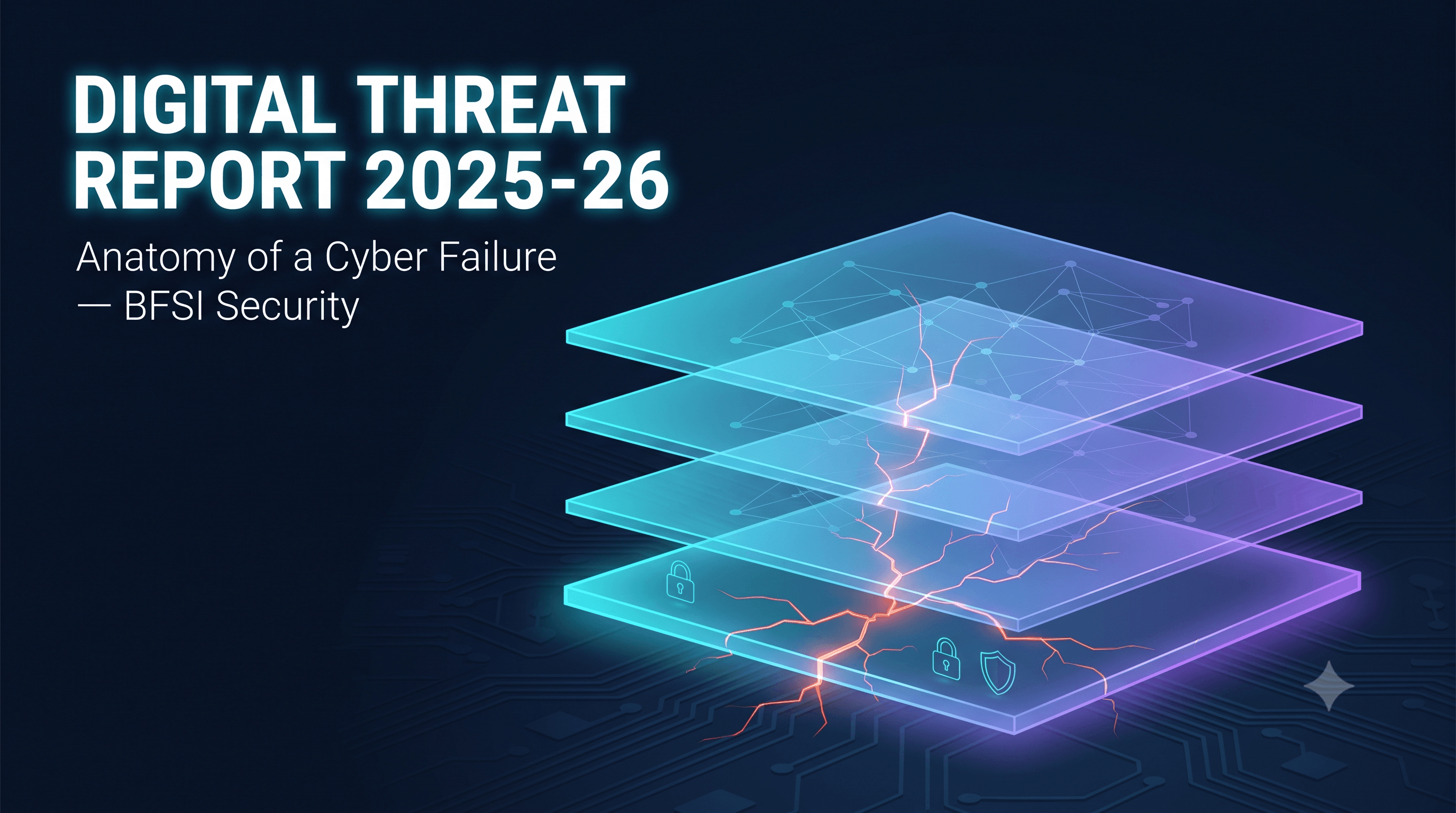
The report tells you what is breaking. This is the engineering work that follows from it.
Executive Summary
On 13 July 2026, the Ministry of Electronics and Information Technology (MeitY) released the second edition of the Digital Threat Report 2025-26 for India's BFSI and payments ecosystem, produced with CERT-In, CSIRT-Fin and SISA.
Its central finding is uncomfortable and specific: six of the seven forward-looking predictions made in last year's edition have already reached full-scale realization. The report frames this as the collapse of the interval between a threat emerging and that threat being operationally exploited — a gap that has compressed "from years to months or even weeks."
The strategic conclusion is that the most damaging attacks no longer look like intrusions. In the report's words, they "surface as legitimate sessions, approved payments, manipulated workflows, or ordinary user behaviour that are indistinguishable from genuine activity until the damage is already done."
That single sentence is a detection engineering brief. If the attack presents as a legitimate session, then your SIEM correlation rules — which were largely written to catch illegitimate sessions — are looking at the wrong side of the problem.
This post does three things:
- Summarises what the report actually says, with sources, and separates verified findings from commentary.
- Walks through the report's Anatomy of Cyber Failure — a 4-layer gap framework — and translates each layer into concrete SIEM, IAM, PAM and logging work.
- Maps the resulting obligations against the Indian regulatory stack: CERT-In's six-hour reporting direction, DPDP breach notification, SEBI CSCRF recovery objectives, and the RBI IT governance Master Direction.
If you run a SOC, own identity infrastructure, or carry the CISO mandate at a bank, NBFC, insurer, broker or payments firm in India, the sections below are written for you.
1. What the Report Actually Found
Let us separate the verifiable findings from the framing.
The prediction scorecard
Last year's edition made seven forward-looking predictions. According to SISA's report portal, six are now operational reality:
- Supply-chain compromise and malicious libraries
- Deepfakes and AI-generated content
- Adversarial LLMs
- LLM prompt hacking
- IoT and embedded-device threats
- Crypto as an attack frontier
The seventh — quantum threat — is classified as still emerging: "not immediate, but impossible to ignore."
Six out of seven in a single cycle is the finding that matters most. It means the forecasting horizon for BFSI threat modelling is now roughly twelve months, not three years. Security architectures budgeted on three-year refresh cycles are structurally behind.
Three shifts defining the landscape
The report groups the threat environment into three shifts:
| Shift | What it covers |
|---|---|
| AI and human deception | Deepfakes, impersonation, synthetic content, AI-assisted fraud — turning trust itself into the attack surface |
| Software and systems | Supply-chain compromise, malicious libraries, APIs, embedded systems |
| Infrastructure and economy | Cloud, crypto, payment rails, and digital financial infrastructure becoming part of the attacker's operating model |
The trust-chain thesis
The report's framing, quoted directly in ANI's coverage of the launch, is that "modern financial attacks are moving from direct compromise to trust-chain manipulation across biometric onboarding, partner apps, AI decisioning, real-time payments, APIs, programmable finance, and third-party ecosystems."
Specific operational observations from the report:
- Deepfake impersonation has become industrialised, including real-time executive video deepfakes, adversarial LLMs, and polymorphic attack variants.
- Credential theft and session hijacking are now the dominant initial-access methods, alongside intensified social engineering and Business Email Compromise.
- Phishing has become context-aware and, per the report, "almost indistinguishable from legitimate communication" — a shift that has made BFSI the most targeted sector.
- Attacks are generated, refined and deployed at machine speed, compressing the time available to detect and respond.
CERT-In Director General Dr. Sanjay Bahl framed the required response as a move "beyond periodic security interventions towards continuous risk assessment, coordinated response and stronger information sharing."
AI asymmetry
The report's named central risk is AI asymmetry: activities that once required specialist teams, significant resources and weeks of effort can now be performed at machine speed by comparatively low-resource threat actors. The consequence is that offensive capability is on a faster development curve than the defensive and regulatory mechanisms designed to contain it.
For context on scale, CERT-In handled over 29.44 lakh cyber incidents in 2025, issuing 1,530 alerts, 390 vulnerability notes and 65 advisories, per figures placed before Parliament.
2. The Anatomy of Cyber Failure: A 4-Layer Gap Framework
The most useful contribution of this edition is not the threat list. It is the diagnostic model.
The report introduces the Anatomy of Cyber Failure, a four-layer gap archetype reconstructed from real forensic investigations. Its argument: a breach is rarely a single lapse. It is a chain of compounding weaknesses that align across four layers.
| Layer | The gap | Plain-language meaning |
|---|---|---|
| 01 Design | Built for correctness, not adversarial reality | The system does what the spec said. The spec never modelled an adversary. |
| 02 Enforcement | Controls exist, but fail under real-world conditions | The policy is written and the tool is licensed. Neither survives contact with production. |
| 03 Signal | The right signals aren't generated or interpreted | The evidence was never logged, never parsed, or never correlated. |
| 04 Response | Even when signals exist, action fails | The alert fired. Nobody had the authority, runbook or tooling to act in time. |
The report maps four recurring breach patterns onto these layers: the Trusted Entry Breach, the Privilege Escalation Breach, the Logic Abuse Fraud, and the Invisible Attack Chain — corresponding to how attackers enter through legitimate channels, expand through weak identity and configuration controls, exploit workflows and APIs, and succeed because signals are missed, fragmented or unavailable.
This is a genuinely useful lens because it tells you where to spend. Most Indian BFSI security budgets over-index on Layer 1 and Layer 2 procurement, and under-invest in Layer 3 and Layer 4 engineering. That is precisely the imbalance the report is describing.
The rest of this post takes each layer and answers one question: what do we actually build?
3. Layer 1 — Design Gaps: Hardening the Onboarding Trust Anchor
Design gaps are where the system was specified without an adversary in the room. In Indian BFSI, the highest-value design gap right now is digital onboarding.
Video KYC, selfie-match and document capture were designed to answer "is this a face that matches this document?" They were not designed to answer "is this face physically present, and is this video stream synthetic?" Industrialised real-time deepfakes attack the second question, which the original spec never asked.
The report's recommendation
The report recommends making active liveness detection the standard for digital onboarding, and enabling cross-database identity verification for high-assurance account openings wherever legally feasible.
What to build
Insist on a certified PAD claim, not a vendor adjective. "Liveness detection" is a marketing term. The measurable standard is ISO/IEC 30107-3 — Information technology, Biometric presentation attack detection, Part 3: Testing and reporting — which defines the methodology for evaluating Presentation Attack Detection (PAD) and the metrics used to report it: APCER (attack presentation classification error rate), BPCER (bona fide presentation classification error rate) and, for full-system evaluations, IAPMR. Testing is conducted at levels of increasing attack sophistication.
When you procure or renew an onboarding vendor, the question is not "do you do liveness?" It is:
- Which ISO/IEC 30107-3 conformance level was tested, and by which accredited lab?
- What are the reported APCER and BPCER figures, and at what operating threshold?
- Which presentation attack instruments were included in the test set — printed photo, replayed video, 3D mask, injected synthetic video stream?
- Does the evaluation cover injection attacks against the camera pipeline, or only physical presentation attacks at the capture device? ISO/IEC 30107-3 addresses attacks "at the biometric capture device during presentation" — injection at the driver or virtual-camera layer is a distinct threat class that needs separate controls.
Instrument the onboarding funnel for the SOC. Onboarding platforms are frequently treated as a business system, not a security log source. That is a Layer 3 failure waiting to happen inside a Layer 1 gap. At minimum, ship these to your SIEM: device fingerprint, virtual-camera detection flags, PAD score per attempt, retry counts per applicant, geolocation-to-document mismatch, and time-to-complete. Bulk onboarding fraud shows up as distributional anomalies in exactly these fields long before it shows up in a fraud loss report.
Model the adversary in design review. Practically: add a mandatory abuse-case section to the design document for any new customer-facing workflow. Three questions, answered in writing — who benefits from subverting this, what is the cheapest way to do it at scale, and what would we see in logs if they did?
4. Layer 2 — Enforcement Gaps: Identity, Sessions and Machine Accounts
Enforcement gaps are where the control exists on paper and fails in production. The report is direct about where this bites hardest: credential theft and session hijacking are now the dominant initial-access methods.
This is the layer where MFA-is-deployed stops being a satisfying answer. Once an attacker holds a valid session token, MFA has already happened. The relevant MITRE ATT&CK techniques are T1539 — Steal Web Session Cookie (Credential Access) and T1550.004 — Use Alternate Authentication Material: Web Session Cookie, which explicitly bypasses MFA because the session is already authenticated. Alongside these, T1621 — Multi-Factor Authentication Request Generation covers MFA fatigue, a technique MITRE attributes to APT29, LAPSUS$ and Scattered Spider.
The report's recommendation
Adopt continuous session assurance using behavioural biometrics, device posture monitoring and token binding for high-privilege sessions, and extend identity governance beyond human users to include service accounts, machine identities and agentic AI.
What to build
Sender-constrain your tokens. Token binding is not a concept — it is a specification. RFC 9449, OAuth 2.0 Demonstrating Proof of Possession (DPoP), published by the IETF in September 2023, describes an application-level mechanism for sender-constraining OAuth 2.0 access and refresh tokens. The client generates an asymmetric key pair, keeps the private key on the device, and presents a short-lived JWT in a DPoP HTTP header on every token and resource request. The authorization server binds the issued token to that public key. A stolen bearer token becomes useless without the private key, and replay becomes detectable.
Start with the sessions that matter: privileged admin consoles, payment initiation and approval flows, and any API path that can move money or change entitlements. Full DPoP rollout across a bank's estate is a multi-quarter programme. Sender-constraining the twenty highest-risk paths is a quarter.
Make session anomaly detection a first-class SIEM use case. Concretely, correlate on the session identifier rather than the user identifier, and alert on:
- A session ID observed from two source IPs in different ASNs within a window shorter than plausible travel time
- User-agent or TLS fingerprint mutation within an established session
- Device posture attribute drift mid-session (OS version, screen resolution, timezone offset)
- A session that authenticated from a managed device and subsequently transacts from an unmanaged one
- Privileged actions occurring in a session whose original authentication event carried a low assurance level
None of these require a new product. They require your identity provider's system log, your reverse proxy or WAF logs, and your EDR telemetry to be in the same correlation domain — which is exactly the integration work covered in our SIEM and IAM integration playbook.
Bring machine identities into governance. The report's instruction to extend identity governance to service accounts, machine identities and agentic AI is not theoretical. CyberArk's 2025 Identity Security Landscape, based on a Vanson Bourne survey of 2,600 cybersecurity decision makers, reports machine identities outnumbering human identities by 82 to 1, with nearly half holding sensitive or privileged access — and most of them unknown and uncontrolled.
The minimum viable programme:
- Discover. Enumerate service accounts, API keys, CI/CD tokens, certificates and agentic AI credentials across on-prem and cloud. In our experience the discovered population is consistently larger than what the CMDB records, because non-human identities are created by pipelines and platform teams rather than by joiner-mover-leaver processes.
- Assign ownership. Every non-human identity gets a named human owner and a business justification. Anything unclaimed after a defined window is a candidate for disablement, staged behind a monitoring period.
- Vault and rotate. Move static secrets into PAM. Set rotation intervals by blast radius, not by convention.
- Baseline behaviour. Machine identities are far more predictable than humans — fixed source ranges, fixed call patterns, fixed hours. That predictability makes them the easiest population to build high-fidelity anomaly detection on. A service account authenticating interactively, or from a new subnet, or outside its historical call pattern, is a near-zero-false-positive signal.
Point 4 is the one most teams skip, and it is the highest-yield detection work available in most BFSI environments.
5. Layer 3 — Signal Gaps: The Logs You Do Not Have
Signal gaps are where the evidence was never generated, never parsed, or never correlated. In the report's breach-pattern language, this is the Invisible Attack Chain — attackers succeed "because signals are missed, fragmented, or unavailable."
This layer is where Indian BFSI SOCs most consistently under-invest, and it is also where regulatory exposure is highest, because the obligations are explicit.
The regulatory floor
CERT-In's Directions under Section 70B(6) of the IT Act, 2000 — No. 20(3)/2022-CERT-In, dated 28 April 2022 — require that all service providers, intermediaries, data centres, body corporate and government organisations "mandatorily enable logs of all their ICT systems and maintain them securely for a rolling period of 180 days," maintained within Indian jurisdiction, and produced to CERT-In on incident reporting or on direction.
Two words in that sentence do the work: all and 180 days. Most log coverage gaps we find during assessments are not refusals — they are omissions. Nobody decided not to log the API gateway. It simply was not on the onboarding list.
The coverage audit worth running this quarter
Build a matrix of every system that can authenticate a user, move money, change an entitlement, or expose customer data. For each, record five facts:
| Column | What you are checking |
|---|---|
| Log generated? | Does the system emit an audit event for this action at all? |
| Log shipped? | Is it reaching the SIEM, or sitting on local disk? |
| Parsed correctly? | Are the fields extracted, or is it landing as unindexed raw text? |
| Retention | Does it meet 180 days hot or accessible, within India? |
| Detection coverage | Is there at least one correlation rule consuming it? |
The gap between column 2 and column 3 is where most SOCs quietly lose their investigation capability. A log that arrives but does not parse is worse than a missing log, because it produces a false sense of coverage on the compliance dashboard.
For SEBI-regulated entities, this exercise maps directly onto the SIEM log coverage requirements in our SEBI CSCRF compliance checklist.
Detection use cases to build against the report's findings
These are the detections that follow directly from what the report says attackers are doing. Build them in this order — the sequencing reflects effort-to-value, not severity.
| # | Detection | Primary log sources | Why it follows from the report |
|---|---|---|---|
| 1 | Service account authenticating outside its behavioural baseline | IdP, AD/Kerberos, PAM vault audit | Machine identity governance gap; near-zero false positive rate |
| 2 | Session identifier reuse across disjoint network origins | IdP system log, reverse proxy, WAF | Session hijacking as dominant initial access (T1550.004) |
| 3 | MFA challenge volume anomaly per user per hour | IdP, MFA provider | MFA fatigue (T1621) preceding account takeover |
| 4 | Privileged action without a corresponding PAM session record | PAM, target system audit, SIEM | Enforcement gap: privileged access bypassing the control path |
| 5 | Payment or entitlement change outside the approving user's historical pattern | Core banking, payment switch, ERP | Business logic abuse — the report's "Logic Abuse Fraud" pattern |
| 6 | Outbound connection from a build agent or CI/CD runner to an unlisted destination | EDR, cloud flow logs, CI/CD audit | Supply chain compromise, now a realized prediction |
| 7 | Cloud control-plane change outside the change window or IaC pipeline | Cloud audit logs (CloudTrail / Activity Log / Audit Logs) | Cloud control-plane risk, named in the report's 2026 shift list |
| 8 | Bulk or anomalous read against customer data stores | Database activity monitoring | DPDP exposure quantification; feeds the 72-hour clock |
Detection 8 deserves a note. When a breach happens, the DPDP report to the Board requires the extent of the breach. If you cannot reconstruct which records were read, you cannot answer that question — and database activity monitoring is the only control that reliably produces that evidence. This is covered in depth in our IBM Guardium implementation roadmap.
6. Layer 4 — Response Gaps: You Are Running Three Clocks
Response gaps are where the alert fired and the organisation still failed. In Indian BFSI, the response gap has a very specific shape, because a single incident starts multiple statutory clocks simultaneously, each with a different trigger, recipient and deadline.
Most incident response plans we review document one of them.
| Clock | Deadline | Trigger | Recipient | Source |
|---|---|---|---|---|
| CERT-In incident reporting | 6 hours | Noticing the cyber incident | CERT-In | Directions No. 20(3)/2022-CERT-In |
| SEBI CSCRF disaster declaration | 30 minutes | Disruption of one or more critical systems | Internal declaration, then DR invocation | SEBI CSCRF FAQs |
| DPDP breach — data principals | Without delay | Becoming aware of a personal data breach | Affected data principals | DPDP Rules 2025, Rule 7(1) |
| DPDP breach — detailed report | 72 hours | Becoming aware of a personal data breach | Data Protection Board of India | DPDP Rules 2025, Rule 7(2) |
Two structural points that catch teams out:
The clocks start at different moments. CERT-In's runs from noticing the incident. DPDP's 72 hours runs from becoming aware that a breach involving personal data has occurred — which is typically later, because it requires establishing that personal data was in scope. These are different timestamps, and both need to be recorded contemporaneously in your incident record. If you cannot evidence when awareness was established, you cannot defend the timeline.
The DPDP report demands forensic content, not a notification. Rule 7(2)(b) requires the detailed report to the Board to cover updated breach details, "the broad facts related to the events, circumstances and reasons leading to the breach," mitigation measures implemented or proposed, "any findings regarding the person who caused the breach," remedial measures to prevent recurrence, and a report on the intimations given to affected data principals. Producing that in 72 hours is an evidence-availability problem, and it resolves back to Layer 3. If the logs were not there, the report cannot be written.
For SEBI-regulated entities, the recovery objectives are additionally prescriptive. Per SEBI's CSCRF FAQs (Q71), on disruption of one or more critical systems the RE must declare the incident a 'Disaster' within 30 minutes, after which the RTO is two hours — as recommended by IOSCO for resumption of critical operations — with an RPO of 15 minutes. These are regulatory floors, not targets you set from your own business impact analysis.
Banks and NBFCs sit under a parallel obligation set: the RBI's Master Direction on Information Technology Governance, Risk, Controls and Assurance Practices, issued 7 November 2023 and in effect from 1 April 2024. It consolidates the RBI's instructions on IT governance, risk, controls, assurance practices and business continuity / disaster recovery management, and applies to commercial banks, NBFCs in the Top, Upper and Middle Layers under Scale Based Regulation, Credit Information Companies, and the All India Financial Institutions (EXIM Bank, NABARD, NaBFID, NHB and SIDBI). Note that it includes a dedicated Audit Trails requirement — the RBI's own version of the Layer 3 problem.
What to build
One incident record, four clock fields. Add explicit timestamp fields to your IR tooling: incident_noticed_at, personal_data_in_scope_confirmed_at, critical_system_disruption_at, and cert_in_reported_at. Make them mandatory. This is a half-day change to a ticket template that materially improves your regulatory defensibility.
Pre-draft the submissions. The CERT-In report format and the DPDP Rule 7 report structure are both known in advance. Templates with the fixed sections pre-filled, and the variable sections marked, convert a 72-hour scramble into a 72-hour investigation.
Rehearse against the tightest clock. Run tabletop exercises timed to the 30-minute SEBI disaster declaration and the 6-hour CERT-In window, not to a comfortable 24-hour scenario. The failure mode you are testing for is not technical — it is that the person authorised to declare is unreachable at 2 a.m.
If your team cannot sustain this response tempo around the clock with in-house headcount, that is a resourcing question rather than a tooling one — and it is the reason SOC as a Service has become the default model for mid-size Indian REs.
7. The 18-Month Roadmap, Translated
The report converts its diagnosis into an 18-month roadmap across three horizons. Here is what SISA publishes for each horizon, and what it means as engineering work.
| Horizon | The report's priorities | What that means on your backlog |
|---|---|---|
| 0–6 months | Strengthen identity, adversarial testing, secrets management, containment | Discover and vault non-human identities. Stand up detections 1–4 from the table above. Run a red team against the onboarding funnel specifically, not just the perimeter. Define containment authority in writing. |
| 6–12 months | Continuous session assurance, transaction monitoring, cloud IAM visibility, control monitoring | Sender-constrain high-privilege sessions (DPoP). Ship cloud control-plane logs into the SIEM with detections attached. Instrument control health as a monitored metric, not an annual attestation. |
| 12–18 months | Identity-centric access, AI supply chain integrity, runtime attestation, third-party risk visibility, post-quantum planning, continuous assurance | Model-and-dependency inventory for AI systems. Runtime attestation on critical workloads. Cryptographic asset inventory as the prerequisite for any PQC migration. |
The report names one operating priority above all: move from proving controls exist to proving they work under real attack conditions.
That distinction is the practical difference between passing an audit and surviving an incident, and it is a fair summary of the gap the report is describing across the whole sector.
8. Compliance-Effective Versus Attack-Effective
The report is explicit that point-in-time attestation does not prove controls will survive adversarial pressure — organisations may pass an audit and remain exposed through implementation drift, scope boundary failures, or framework evolution lag.
That is worth making concrete.
| Control | Compliance-effective looks like | Attack-effective looks like |
|---|---|---|
| MFA | MFA is enabled for all users; screenshot in evidence folder | Session tokens are sender-constrained; session anomalies alert in under 5 minutes |
| Log retention | 180 days retained, per CERT-In direction | Every in-scope source parses correctly and has at least one detection consuming it |
| Privileged access | PAM deployed; privileged accounts onboarded | Every privileged action reconciles to a PAM session; exceptions alert |
| Vendor risk | Annual questionnaire on file | Vendor-originated identities are inventoried, scoped and behaviourally baselined |
| Onboarding | Video KYC operational and regulator-approved | PAD tested to ISO/IEC 30107-3 with published APCER/BPCER; funnel telemetry in the SIEM |
| Incident response | IR policy approved by the board | Four statutory clocks tracked per incident; tabletop run against the 6-hour window |
| DR | RTO/RPO documented | RTO of 2 hours and RPO of 15 minutes demonstrated in a live drill |
The left column is what most Indian BFSI organisations can evidence today. The right column is what the Digital Threat Report is asking for.
FAQ
What is the Digital Threat Report 2025-26?
It is the second edition of an executive cybersecurity assessment for India's BFSI and payments ecosystem, released on 13 July 2026 by MeitY along with CERT-In, CSIRT-Fin and SISA. It draws on digital forensics and incident response research, CERT-In and CSIRT-Fin incident observations, and research into adversarial AI.
What does "six of seven predictions realized" actually mean?
Last year's edition made seven forward-looking predictions. Six — supply-chain and malicious libraries, deepfakes and AI content, adversarial LLMs, LLM prompt hacking, IoT and embedded-device threats, and crypto as an attack frontier — are now described as operational reality. Only the quantum threat remains classified as emerging. The practical implication is that your threat modelling horizon should be treated as roughly twelve months.
Is this report binding on regulated entities?
No. The Digital Threat Report is guidance, not a circular or direction. Your binding obligations come from CERT-In's Directions under Section 70B(6), the DPDP Act and DPDP Rules 2025, SEBI's CSCRF for SEBI-regulated entities, and the RBI's IT governance Master Direction for banks and NBFCs. The report is best read as the threat evidence that explains why those obligations are shaped the way they are.
Our SIEM already ingests authentication logs. Is that enough for session hijacking detection?
Usually not. Authentication logs tell you a session started. Session hijacking happens after that event. Detecting it requires correlating on the session identifier across the identity provider, the reverse proxy or WAF, and endpoint telemetry — so that origin, device posture and user-agent changes within an established session become visible. If those three sources are not in the same correlation domain, the detection cannot be written.
What is the difference between the CERT-In six-hour clock and the DPDP 72-hour clock?
They are separate obligations with different triggers and recipients. CERT-In's six-hour window runs from noticing a cyber incident and reports to CERT-In. The DPDP 72-hour window runs from becoming aware that a breach involving personal data has occurred, and delivers a detailed report to the Data Protection Board of India — alongside a separate obligation to intimate affected data principals without delay. A single incident can start both, at different timestamps.
We are a mid-size NBFC. Where do we start?
Start at Layer 3, not Layer 1. Run the log coverage audit described in section 5 — generated, shipped, parsed, retained, detected — across every system that can authenticate a user, move money, change an entitlement or expose customer data. It is the cheapest exercise on this list, it is required evidence under the CERT-In direction regardless, and it tells you which of the other layers you can actually detect failures in today.
Does any of this change our DPDP readiness work?
It sharpens one part of it. The report's emphasis on signal gaps maps directly onto the DPDP Rule 7 requirement to report the extent of a breach within 72 hours. Without database activity monitoring and reliable data-store logs, that report cannot be produced accurately — which turns a detection gap into a regulatory one. Our DPDP audit and compliance service covers this assessment.
Building These Controls with Cyberaube
The Digital Threat Report is a diagnosis. Closing the four gap layers is implementation work, and it needs practitioners who have operated these platforms in production rather than assessed them from a checklist.
Cyberaube works with Indian BFSI organisations on exactly this stack: SIEM detection engineering on QRadar and Splunk, IAM and PAM implementation across CyberArk, Okta and SailPoint, database activity monitoring with IBM Guardium, and 24/7 managed SOC operations that can sustain a six-hour reporting tempo. Where you need capability inside your own team rather than outside it, we place certified specialists on contract and permanent terms.
If you are working through the log coverage audit, the non-human identity discovery, or the incident response clock mapping described above, we can help you scope and execute it.
Talk to our team about detection engineering and SOC coverage
Conclusion
The finding to carry out of this report is not the threat list. It is the compression.
Six of seven predictions realized in a single cycle means the interval between a threat being described and that threat being used against an Indian bank is now shorter than most enterprise procurement processes. You cannot buy your way to parity on that timeline. You can only shorten your own detection and response loop.
The four-layer framework is useful precisely because it points spending at the layers most Indian BFSI organisations neglect. Design and enforcement gaps get budget because they map onto products. Signal and response gaps get neglected because they map onto engineering hours and organisational authority — and those are harder to requisition.
Start where the report and the regulator agree. Know what you log. Know what parses. Know who can declare an incident at 2 a.m., and know which of the four clocks is already running.
Request a SIEM and log coverage assessment
About the Author
Saurabh Pande is Co-Founder of Cyberaube Technologies with 13+ years of experience across enterprise security platforms including IBM Security, CyberArk, and QRadar. He has interviewed and placed 2,500+ cybersecurity professionals across SIEM, PAM, and IAM disciplines, and advises BFSI organizations on security operations strategy and compliance readiness.
About Cyberaube
Cyberaube provides cybersecurity staffing, 24/7 managed security services, and expert consulting for SIEM, IAM, and data protection platforms. Our certified specialists implement and operate QRadar, Splunk, ArcSight, CyberArk, Okta, SailPoint, and integrated security stacks for enterprises across India and globally.