DPDP Compliance Checklist 2026: What Every Data Fiduciary Needs by 13 May 2027
A practical DPDP Act compliance checklist: notice, consent, security safeguards, breach reporting, retention and rights, mapped to the DPDP Rules 2025 deadlines.

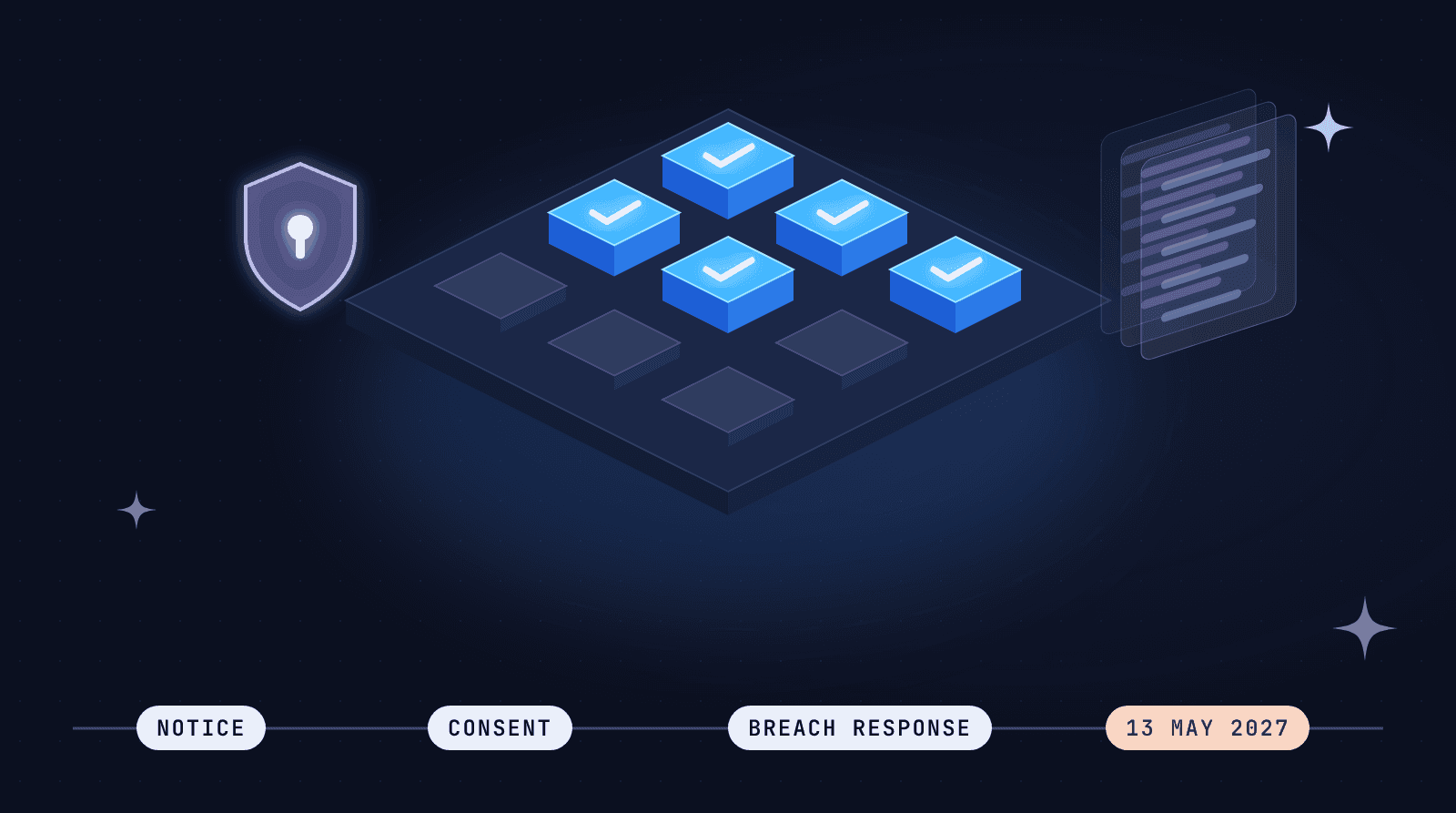
India's DPDP Rules 2025 give ordinary Data Fiduciaries until 13 May 2027. That is about six months from today, and the items with the longest lead times are logging, retention and data mapping, not policies.
This checklist covers what a Data Fiduciary has to have in place, rule by rule, so you can see where you stand and what to start first. For the full reading of the Gazette, the commencement dates and the Consent Manager regime, see our DPDP Rule 4 and 13 November 2026 explainer.
The DPDP Deadlines at a Glance
The Digital Personal Data Protection Rules, 2025 were notified on 13 November 2025 (G.S.R. 846(E)) and commence in three stages.
| Date | What commences | Who it binds |
|---|---|---|
| 13 Nov 2025 | Definitions and the Data Protection Board provisions | The Board and Government |
| 13 Nov 2026 | Rule 4: Consent Manager registration and obligations | Consent Managers only |
| 13 May 2027 | Rules 3 and 5 to 16, 22 and 23: notice, security safeguards, breach intimation, erasure, children's data, Significant Data Fiduciary duties, rights and cross-border transfer | Every Data Fiduciary |
If you are not becoming a Consent Manager, 13 May 2027 is your date.
Checklist 1: Know What Personal Data You Hold
You cannot write a compliant notice, retain or erase data correctly, or size a breach without an inventory.
- Inventory of personal data by category, system and owner, including copies held by your Data Processors
- Data-flow maps showing where each category is collected, stored, shared and sent outside India
- Purpose recorded for each category, so notices and consent can be specific
- Children's data and data of persons with disabilities identified separately
- Decision recorded on whether you are likely to be notified as a Significant Data Fiduciary
Checklist 2: Notice and Consent (Section 6, Rule 3)
- Notice that can be understood on its own, without reference to other documents
- Itemised description of the personal data and the specific purposes for each
- A link or other means to withdraw consent that is as easy as giving it
- Clear routes to exercise rights and to complain to the Data Protection Board
- Consent stored as timestamped evidence linked to the exact notice version shown, because Section 6(10) puts the burden of proof on you
- Consent withdrawal that reaches your Data Processors and downstream systems, as Section 6(6) requires
Checklist 3: Reasonable Security Safeguards (Rule 6)
This is the obligation with the ₹250 crore maximum penalty. Rule 6(1) sets a minimum list.
- Encryption, masking, obfuscation or tokenisation of personal data (6(1)(a))
- Access control over systems that hold personal data, including privileged access (6(1)(b))
- Logs and monitoring that show who accessed personal data, not only who logged in (6(1)(c))
- Backups and continuity measures so processing can continue after an incident (6(1)(d))
- Logs and personal data retained for one year for investigation (6(1)(e))
- Security obligations written into every Data Processor contract (6(1)(f))
- Governance that shows the measures are actually observed (6(1)(g))
The item most teams miss is 6(1)(c). Identity provider logins do not show access to the data itself. Most enterprises need database activity monitoring and a SIEM where identity and data-access events can be correlated. Our SIEM, IAM and PAM integration guide covers how to build that.
Checklist 4: Breach Response (Rule 7)
- Process to inform each affected individual without delay, with the nature, extent and timing of the breach, likely consequences, mitigation and a contact person
- Process to inform the Data Protection Board without delay
- Detailed report to the Board within 72 hours of becoming aware, including causes, remediation and the notices sent to individuals
- Alignment with CERT-In's six-hour reporting for listed cyber incidents, which already applies today
- A tested way to work out which individuals and which data were affected within 72 hours
- At least one breach simulation run against all of these clocks
Checklist 5: Retention and Erasure (Rule 8)
- Retention schedule per data category with both a minimum and a maximum period
- Personal data, traffic data and processing logs kept for at least one year from processing (Rule 8(3))
- Erasure once the purpose is served, unless another law requires you to keep the data
- For large e-commerce, online gaming and social media platforms in the Third Schedule: erasure after three years of inactivity, with a notice at least 48 hours before erasure
- CERT-In's 180-day log retention in India factored into the same design, so you build to the longest requirement that applies
Checklist 6: Data Principal Rights and Contact Point
- Workflow to handle requests for access, correction, completion and erasure
- Grievance redressal process with tracked response times
- Identity verification for people making requests
- Published contact details of your DPO, or of a person who can answer questions about your processing (Rule 9)
Checklist 7: Children's Data (Section 9, Rule 10)
- Verifiable parental consent before processing a child's personal data
- No tracking, behavioural monitoring or targeted advertising directed at children
- Due diligence that the person giving consent for a child is the parent and an identifiable adult
Checklist 8: Significant Data Fiduciaries (Section 10, Rule 13)
Only if the Government notifies you as a Significant Data Fiduciary.
- A Data Protection Officer based in India, and an independent data auditor
- A Data Protection Impact Assessment and an audit every twelve months, with significant observations reported to the Board
- Checks that algorithms you use do not put Data Principals' rights at risk
- Readiness for any data localisation restriction the Government specifies
Checklist 9: Processors and Cross-Border Transfers
- Contracts with every Data Processor covering security, breach notice, erasure and consent withdrawal
- List of personal data sent outside India and the countries involved
- A way to follow any order the Government issues under Rule 15 on transfers abroad
What the Penalties Look Like
| Breach | Maximum penalty |
|---|---|
| Failure to take reasonable security safeguards | ₹250 crore |
| Failure to notify a personal data breach | ₹200 crore |
| Breach of obligations for children's data | ₹200 crore |
| Breach of Significant Data Fiduciary obligations | ₹150 crore |
| Breach of any other provision | ₹50 crore |
Penalties follow an inquiry by the Data Protection Board and a finding that the breach is significant.
Where to Start in the Next Six Months
About 175 days remain until 13 May 2027. In order:
- Data inventory and mapping (Checklist 1). Everything else depends on it.
- Log coverage audit for access to personal data, and sizing of one-year retention against your current SIEM licence and storage (Checklist 3 and 5). These are budget decisions with long lead times.
- Processor contract amendments (Checklist 9). You do not control the other side's timeline.
- Notice, consent capture and withdrawal (Checklist 2).
- Breach simulation against the 72-hour and six-hour clocks (Checklist 4).
If you are SEBI-regulated, much of the logging and access work overlaps with CSCRF. Our SEBI CSCRF checklist shows where.
FAQ
When do the DPDP Rules apply to my company?
For an ordinary Data Fiduciary, the substantive obligations in Rules 3 and 5 to 16 commence on 13 May 2027, eighteen months after the DPDP Rules 2025 were notified on 13 November 2025. Rule 4, which commenced on 13 November 2026, applies only to Consent Managers.
What is the maximum DPDP penalty?
Up to ₹250 crore for failing to take reasonable security safeguards. Failing to notify a personal data breach to the Board or affected individuals can cost up to ₹200 crore, as can breaching the obligations for children's data. Breach of any other provision carries up to ₹50 crore.
Do we need a Data Protection Officer?
Only Significant Data Fiduciaries must appoint one. Every Data Fiduciary must still publish the contact details of a person who can answer questions about its processing of personal data.
How quickly must a personal data breach be reported under DPDP?
Affected individuals and the Data Protection Board must be told without delay, and a detailed report must reach the Board within 72 hours of becoming aware of the breach. CERT-In's separate six-hour reporting requirement for listed cyber incidents still applies.
How long must logs be kept under the DPDP Rules?
At least one year. Rule 6(1)(e) requires logs and personal data to be retained for one year for detecting and investigating unauthorised access, and Rule 8(3) requires personal data, traffic data and processing logs to be kept for a minimum of one year from the date of processing.
Get a DPDP Gap Assessment
Cyberaube runs fixed-price DPDP gap assessments that test each item on this checklist against evidence, not just policy documents. See our DPDP audit and compliance services, or compare DPDP compliance tools and software if you are choosing a platform.
About the Author
Saurabh Pande is Co-Founder of Cyberaube Technologies with 13+ years of experience across enterprise security platforms including IBM Security, CyberArk, and QRadar. He has interviewed and placed 2,500+ cybersecurity professionals across SIEM, PAM, and IAM disciplines, and advises BFSI organizations on security operations strategy and compliance readiness.