Top 7 DPDP Compliance Tools & Software for 2026
Compare the best DPDP compliance tools and software for 2026 — consent management, data discovery, audit evidence — and how to pick the right platform.

Executive Summary
India’s data protection landscape is transforming rapidly, with stronger expectations around accountability, transparency, and enforceable safeguards in business operations.
In response to heightened regulatory scrutiny and maturing enforcement, organizations are increasingly working with DPDP compliance consultants in India to translate legal requirements into sustainable, auditable practices. By 2026, effective DPDP compliance depends on integrated tools, well-defined frameworks, and continuous oversight that embeds privacy into day-to-day decision-making.
India’s DPDP Act and the New Compliance Environment
The Digital Personal Data Protection Act, 2023 (DPDP Act) is India’s first comprehensive legislation governing the full lifecycle of personal data. It regulates collection, processing, storage, transfer, and deletion, with accountability assigned directly to organizations handling the personal data of Indian citizens.
The law applies broadly, including to global enterprises with Indian customers, employees, or data flows. A key characteristic of DPDP is demonstrable compliance: organizations must show how they obtain consent, manage risks, prepare for breaches, and respect data principal rights.
Why Expert Guidance Is Essential in 2026
DPDP compliance intersects legal interpretation, cybersecurity, risk management, and governance. When these are managed in silos, organizations often end up with fragmented controls and audit exposure.
This is why many enterprises combine DPDP readiness with specialized cybersecurity consulting and align DPDP obligations with adjacent regulatory expectations (for example, the SEBI Cybersecurity Framework where applicable). Integrated compliance reduces duplication, improves operational efficiency, and increases executive confidence that controls are sustainable.
The Role of Tools and Frameworks in DPDP Compliance
Manual compliance approaches are no longer viable in data-driven organizations. Modern DPDP compliance relies on automation and standardized frameworks to ensure consistency, traceability, and audit readiness.
Well-chosen tools help organizations move from reactive compliance to proactive data governance, reducing long-term regulatory and operational risk.
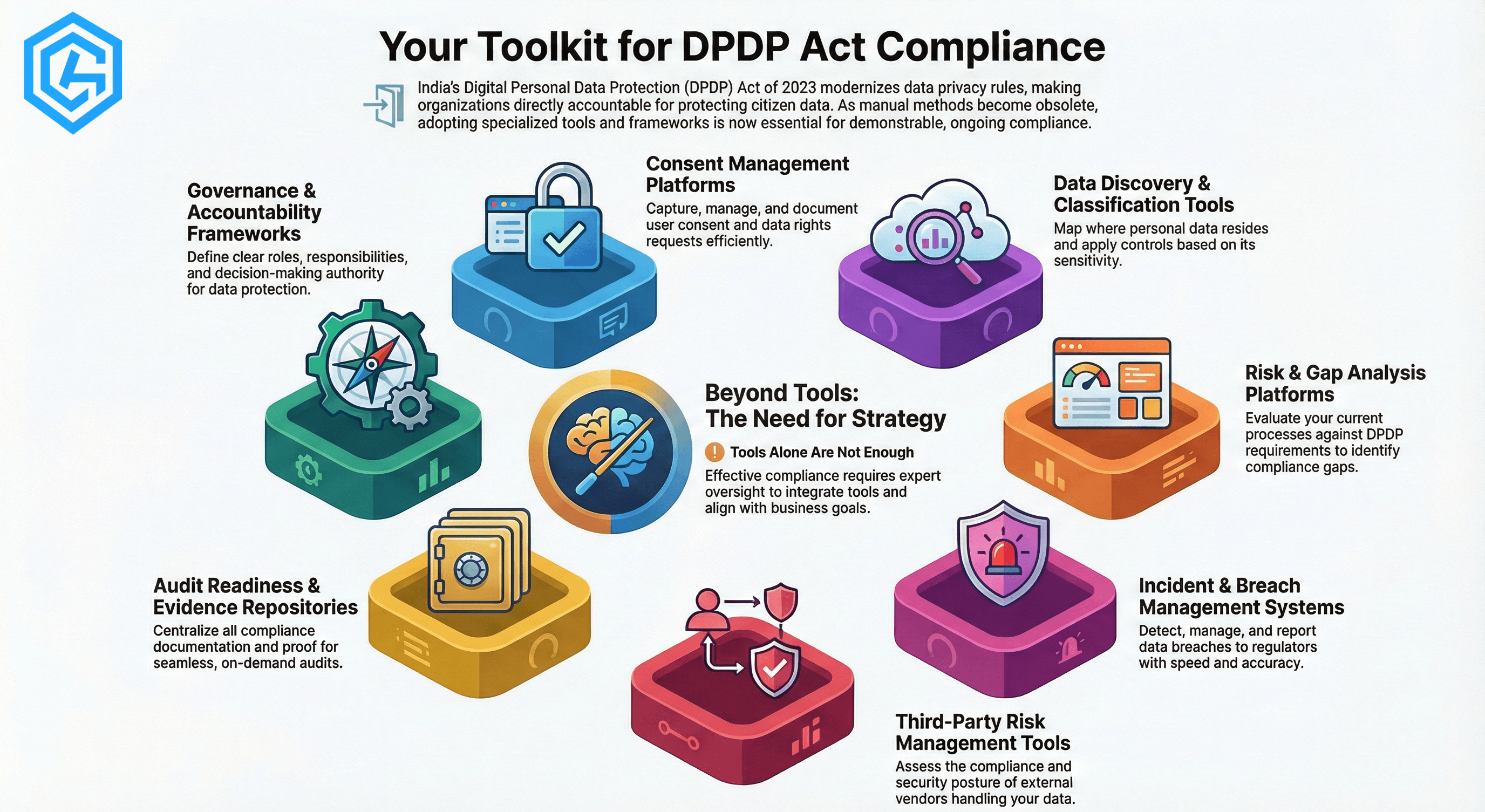
Top 7 DPDP Compliance Tools and Frameworks Recommended in 2026
1) DPDP Governance and Accountability Frameworks
Governance frameworks form the foundation of DPDP compliance. They define roles, responsibilities, escalation paths, and decision-making authority across departments.
In 2026, many organizations align DPDP governance with global privacy and cybersecurity standards so programs remain scalable and resilient as regulatory expectations evolve.
2) Consent and Data Principal Rights Management Platforms
Consent management platforms help capture, manage, and document consent across channels. They also enable workflows for data principal rights (access, correction, erasure), ensuring responses are timely, auditable, and DPDP-aligned.
3) Data Discovery and Classification Tools
Data discovery identifies where personal data lives, how it flows through systems, and who can access it. Automated classification allows organizations to apply controls based on sensitivity, supporting DPDP principles like data minimization and purpose limitation.
For example, a data discovery initiative can reveal redundant legacy datasets; deleting those reduces storage costs and meaningfully lowers breach exposure.
4) Risk Assessment and Compliance Gap Analysis Platforms
Risk and gap analysis tools evaluate policies, technical controls, and operational processes against DPDP requirements. They provide visibility into gaps, remediation priorities, and progress tracking.
These platforms are frequently used with DPDP consulting services in India to ensure assessments are regulator-aligned and operationally actionable.
5) Incident Response and Breach Management Systems
The DPDP Act emphasizes breach preparedness and notification. Incident response tooling integrates with security monitoring to detect anomalies, manage investigations, document impact assessments, and support fast, accurate notifications.
6) Third-Party and Vendor Risk Management Tools
Third parties often represent significant compliance risk. Vendor risk tools assess contracts, security posture, and DPDP alignment of processors handling personal data.
This ensures accountability extends beyond internal systems to the broader processing ecosystem.
7) Audit Readiness and Evidence Management Repositories
Audit readiness platforms centralize policies, logs, assessments, and evidence. They reduce audit fatigue, improve transparency, and enable organizations to demonstrate compliance without last-minute documentation drills.
Talk to Cyberaube about building an audit-ready DPDP program
Free download: the DPDP Compliance Guide (PDF). Penalties, liability, consent obligations, and a practical readiness checklist — everything in this article condensed into a reference you can share with your leadership team. Get the free guide
Navigating India’s Compliance Landscape with Structured Support
India’s evolving regulatory environment requires organizations to balance legal obligations with operational efficiency.
Cybersecurity consulting services focused on DPDP Act compliance and SEBI cybersecurity alignment can help organizations assess gaps, design compliant programs, and reach audit readiness with confidence.
Midway through many compliance journeys, organizations see the value of DPDP Act compliance solutions in India that integrate governance, automation, and continuous monitoring instead of relying on fragmented controls.
Strategic Importance of the Right Compliance Partner
Tools alone are not enough. Strategic oversight is essential to ensure controls remain effective as data environments and business models change.
This is where a DPDP compliance consultant in India plays a critical role—bridging regulatory interpretation, technical execution, and audit preparedness.
By combining structured frameworks, advanced tooling, and expert oversight, Cyberaube Technologies helps organizations build DPDP compliance programs that are practical, scalable, and aligned with long-term business objectives.
Preparing for the Future of DPDP Compliance
DPDP compliance is an ongoing process, not a one-time milestone. Continuous monitoring, periodic assessments, and regular audits are essential to maintaining regulatory confidence.
Organizations that invest early in structured compliance frameworks gain lasting advantages in trust, resilience, and operational efficiency.
FAQ
Does the DPDP Act apply to foreign organizations?
Yes. Any organization processing personal data of Indian citizens must comply, regardless of location.
Are DPDP compliance tools mandatory?
While not legally mandated, automation significantly improves accuracy, scalability, and audit readiness.
How often should DPDP compliance assessments be conducted?
At least annually, and whenever there are significant changes to data processing activities.
Can DPDP compliance align with SEBI cybersecurity requirements?
Yes. Integrated compliance frameworks reduce duplication and simplify audits.
What is the biggest DPDP challenge in 2026?
Maintaining continuous compliance across expanding data ecosystems and third-party relationships.
DPDP Act Compliance Consulting
Tools alone don't make you compliant — someone has to run the gap assessment, map your data flows, and produce audit evidence. Cyberaube Technologies provides DPDP compliance services in India — readiness audits, data discovery, consent audit, and DPO-as-a-Service — and integrates DPDP with existing SEBI CSCRF and RBI IT Governance frameworks to reduce duplication.
Explore our DPDP audit and compliance services or book a DPDP readiness assessment.
Related reading: SEBI CSCRF Compliance Checklist for 2026 · SEBI CSCRF Compliance Playbook for BFSI
Book Your Appointment Today
If your organization is preparing for India’s evolving data protection landscape, expert guidance can be the difference between reactive compliance and long-term resilience.