Top Cybersecurity Best Practices for Businesses in 2026
Ten practices for Indian businesses in 2026, each tied to what DPDP, CERT-In, SEBI CSCRF and RBI actually require — not generic advice.

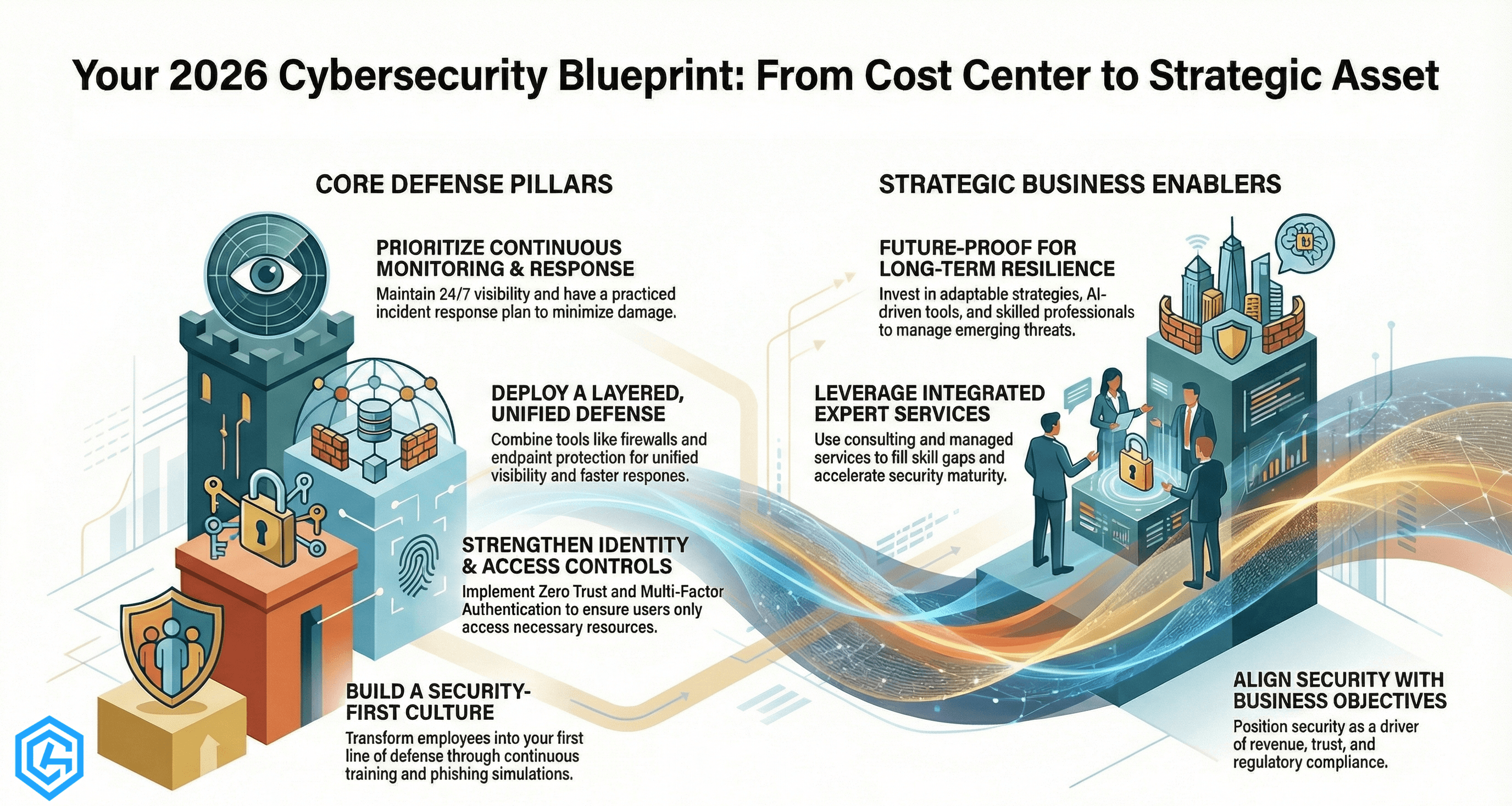
Executive Summary
Most "cybersecurity best practices" lists are written for nobody in particular. This one is written for organisations operating in India in 2026, because that is where the requirements are specific enough to be actionable.
Four things changed the baseline for Indian businesses: the DPDP Act 2023 brought personal data handling under statutory obligation, CERT-In's 28 April 2022 direction imposed six-hour incident reporting and 180-day log retention within Indian jurisdiction, SEBI's CSCRF set tiered requirements for regulated entities, and RBI's Cybersecurity Directions took effect on 31 July 2026 with specified arrangements for the security operations function. Most mid-sized Indian firms are now subject to at least two of these at once.
The ten practices below are ordered roughly by dependency — the early ones are what the later ones are built on. Each links to a deeper treatment where we have one.
Last updated: 2 September 2026.
Top 10 Cybersecurity Best Practices for Business in 2026
1) Get centralised logging right before anything else
Every framework above assumes you have logs. CERT-In's direction is explicit: a rolling 180 days, held within Indian jurisdiction, and — the part organisations miss — in a form you can actually query, not a cold archive you would need a week to restore.
This is the practice everything else depends on. You cannot detect, investigate, or evidence a control without it. It is also the one most often broken silently, during platform migrations, when export from the old system and ingestion into the new are not run in parallel with verified overlap.
If you are choosing or replacing a SIEM, our QRadar alternatives shortlist works through the platform options against exactly these residency and retention constraints.
2) Fix identity before buying more tools
Identity is where audits actually fail. Not missing products — privileged access granted for a project three years ago and never revoked, service accounts with no owner, and entitlement reviews that exist as a policy document and not as a record.
The practical baseline:
- Least privilege, enforced rather than documented
- Multi-factor authentication on every administrative path, including break-glass
- Scheduled entitlement reviews that produce evidence, with a named reviewer
- Privileged access with session recording for anything touching regulated data
- Joiner-mover-leaver processes that actually revoke on the leaver step
Identity and detection are more useful together than separately — see our SIEM and IAM integration playbook for how the two feed each other.
3) Build layered defence, and integrate it
No single control stops everything. Endpoint protection, network segmentation, secure configuration, and detection each catch what the others miss.
The failure mode is not missing layers, it is disconnected ones. Six tools that do not share context produce six partial views and no complete one — and an analyst reconstructing an incident by hand at 3 a.m. is how six-hour reporting deadlines get missed.
4) Design monitoring around the six-hour clock
CERT-In requires specified incidents to be reported within six hours of noticing. That is an operational design constraint, not a policy one. If nobody is watching telemetry overnight, the clock runs while nobody is awake to start it.
What this requires in practice: continuous coverage across network, endpoint, identity and cloud; alerting tuned well enough that real signals are not buried; a documented and rehearsed response plan; and a named person who can authorise a regulatory filing outside business hours.
Whether you staff that yourself or not is a separate question — see practice 7, and our SOC as a Service guide for the cost comparison.
5) Secure cloud and hybrid estates against the residency question
Misconfiguration remains a leading cause of breaches, and the shared responsibility model is still widely misread as "the provider handles security."
Core practices — encryption in transit and at rest, continuous configuration monitoring, periodic privilege cleanup, workload protection matched to the provider. For Indian organisations there is an additional filter that global guidance omits: which region the data and the logs actually sit in. A supported region for a core service does not mean every feature is available in that region, and feature-level residency gaps typically surface after contracts are signed. Get it in writing, feature by feature.
Talk to Cyberaube about strengthening your 2026 security roadmap
6) Know precisely which regulations apply to you
"Regulatory expectations are expanding" is not useful. What is useful is a short, accurate list of what binds you:
| If you are… | You are subject to |
|---|---|
| Any org processing personal data in India | DPDP Act 2023 — consent, notice, data principal rights, breach notification |
| Any org running ICT systems in India | CERT-In direction, 28 Apr 2022 — 6-hour reporting, 180-day logs in-jurisdiction |
| A SEBI-regulated entity | CSCRF — tiered by MII / Qualified RE and below |
| An RBI-regulated entity | Cybersecurity Directions 2026, in force 31 July 2026 |
Deeper treatments: DPDP consent manager obligations, the SEBI CSCRF checklist, RBI's 2026 Directions, and CERT-In's threat report for BFSI. If you need the position assessed formally, that is what our DPDP audit service does.
7) Solve the staffing constraint honestly
For most Indian mid-market organisations the binding constraint is not tooling. It is that 24/7 detection needs roughly eight analysts across shifts, and hiring them is slow, expensive and competitive.
There are three honest options: build and staff it, co-manage it, or outsource it. Changing your SIEM will not fix a staffing problem, and a migration will consume the senior people you do have for two or three quarters. We do cybersecurity staffing and managed SOC services, so weigh that accordingly — but the logic holds whoever provides it.
8) Make security evidence-producing, not just effective
Auditors do not ask whether you have a control. They ask you to demonstrate it on a specific date. A control that works but produces no retrievable evidence will fail an audit anyway.
Design for this deliberately: retention that can be queried by date range, access reviews that leave a record with a named reviewer, incident timelines reconstructable after the fact, and change management that ties a configuration to a person and a date.
9) Treat migrations and major changes as risk events
The most common way a well-run security programme creates an exposure is during a change — a SIEM migration, a cloud move, a merger. Detection coverage drops, log continuity breaks, and the gap is invisible until someone asks for evidence covering those weeks.
Run parallel systems with verified overlap, document the risk assessment, and get sign-off before cutover. If you are RBI- or SEBI-regulated, treat the change itself as requiring documented approval, not as routine IT work.
10) Build for what you cannot predict
AI-assisted attack tooling, behavioural analytics and automated response are all reshaping defence, and nobody knows precisely how. What survives uncertainty is not tool selection — it is centralised logging, clean identity, retrievable evidence, and people who understand your environment.
Organisations that have those four can adopt almost anything. Organisations that do not will buy tools that sit unconfigured.
FAQ
What cybersecurity regulations actually apply to an Indian business in 2026?
It depends on what you are and what data you hold. Almost every organisation processing personal data falls under the DPDP Act 2023. Any organisation running ICT systems in India falls under CERT-In's 28 April 2022 direction — six-hour incident reporting and 180 days of logs held within Indian jurisdiction. On top of that, SEBI-regulated entities have CSCRF, and RBI-regulated entities have the Cybersecurity Directions that took effect on 31 July 2026. Most mid-sized Indian firms are subject to at least two of these simultaneously, which is why a single generic checklist rarely survives contact with an audit.
What is the six-hour rule, and does it apply to us?
CERT-In's April 2022 direction requires that specified cyber incidents be reported to CERT-In within six hours of noticing them. It applies broadly to organisations operating ICT infrastructure in India, not only to regulated financial entities. Six hours is short enough that it is an operational design problem rather than a policy one — if nobody is watching your telemetry overnight, the clock is running while nobody is awake to start it.
How long do we have to keep security logs in India?
CERT-In's direction requires a rolling 180 days of ICT system logs, maintained within Indian jurisdiction. Two practical consequences: your SIEM needs to hold 180 days in a queryable form rather than cold archive, and any platform migration has to run old and new systems in parallel with verified overlap, or you create a window where a compliant 180-day history exists on neither.
Do we need our own SOC, or can we outsource it?
Both are legitimate. The deciding constraint is usually analyst headcount rather than tooling — 24/7 coverage needs roughly eight analysts across shifts, which is out of reach for most mid-sized Indian firms. Note that RBI's 2026 Directions specify CSOC arrangements for regulated entities, so if you are RBI-regulated the structure is partly prescribed rather than optional.
Where do most Indian organisations actually fail an audit?
Rarely on missing tools. Most commonly on identity and logging evidence: privileged access that was granted for a project and never revoked, service accounts nobody owns, and log retention that exists in principle but cannot be produced for a specific date range on request. Auditors ask you to demonstrate a control on a particular day, not to show that you bought a product.
Is compliance the same thing as security?
No, but in India in 2026 they have converged more than they used to. DPDP, CERT-In, CSCRF and the RBI Directions each specify operational capabilities — detection, retention, response timelines, reporting lines — rather than paperwork alone. Treating them as a documentation exercise is what produces organisations that are technically compliant and practically indefensible.
Where should a mid-sized business start if it has none of this in place?
Start with logging and identity, in that order. Without centralised logs you cannot detect, investigate or evidence anything, and every framework above assumes you have them. Without identity hygiene, your logs record an attacker using valid credentials. Culture, tooling and architecture all matter, but they compound on top of those two rather than substituting for them.
How often should we reassess?
Continuously for detection coverage, and formally after any material change — a platform migration, a new regulated product, a merger, or a change in what regulations apply to you. A fixed annual review that ignores a mid-year SIEM migration is how retention gaps and detection blind spots survive to audit.
Managed Security Services for Businesses in 2026
Implementing cybersecurity best practices requires the right tools and the right team. Cyberaube Technologies provides 24/7 managed security services across SIEM, IAM, and data protection platforms — helping businesses maintain continuous monitoring, rapid incident response, and compliance readiness without building an in-house SOC.
Explore our managed security services or book a cybersecurity consultation.
Ready to Strengthen Your Cybersecurity Posture?
If you want an independent read on where you stand against DPDP, CERT-In, CSCRF or the RBI Directions — including an honest answer about which of them actually apply to you — book a free scoping call. No cost, no obligation.